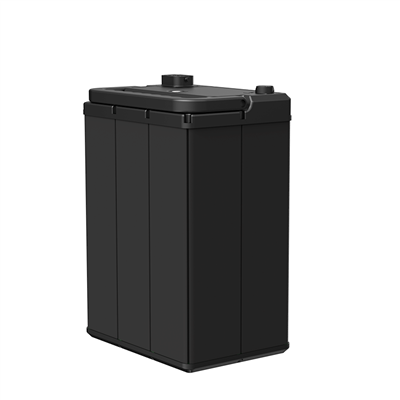

As a supplier of 12.8V 24Ah trolley batteries, I've witnessed firsthand the importance of understanding how the depth of discharge (DoD) impacts the lifespan of these energy storage solutions. In this blog, I'll delve into the science behind DoD, its effects on battery longevity, and how you can optimize your battery usage to extend its service life.
Understanding Depth of Discharge
Depth of discharge refers to the percentage of a battery's capacity that has been used relative to its total capacity. For example, if a 12.8V 24Ah trolley battery has a DoD of 50%, it means that 12Ah (half of its 24Ah capacity) has been discharged. DoD is a critical factor in battery performance and lifespan because it directly affects the chemical reactions occurring within the battery cells.
When a battery is discharged, the chemical reactions inside the cells convert stored chemical energy into electrical energy. As the DoD increases, these reactions become more intense, leading to greater stress on the battery components. Over time, this stress can cause irreversible damage to the battery cells, reducing their capacity and overall lifespan.
The Impact of DoD on Battery Lifespan
The relationship between DoD and battery lifespan is inverse: the higher the DoD, the shorter the battery's lifespan. This is because deep discharges cause more significant stress on the battery cells, leading to faster degradation of the active materials and the formation of internal resistance.
Shallow Discharges (Low DoD)
Shallow discharges, typically defined as DoD levels below 20%, are the least stressful for battery cells. When a battery is discharged to a low DoD, the chemical reactions inside the cells are relatively mild, and the battery experiences minimal wear and tear. As a result, batteries that are regularly subjected to shallow discharges can have a significantly longer lifespan compared to those that are deeply discharged.
For example, a 12.8V 24Ah trolley battery that is consistently discharged to a DoD of 10% may be able to withstand thousands of charge-discharge cycles before its capacity drops to an unacceptable level. This makes shallow discharges an ideal operating condition for applications where long battery life is a priority, such as in backup power systems or electric vehicles.
Deep Discharges (High DoD)
Deep discharges, on the other hand, can have a detrimental effect on battery lifespan. When a battery is discharged to a high DoD, the chemical reactions inside the cells become more intense, leading to the formation of dendrites (tiny metal filaments) on the electrodes. These dendrites can cause short circuits within the battery cells, reducing their capacity and increasing the risk of thermal runaway (a dangerous condition where the battery overheats and can potentially catch fire or explode).
In addition to dendrite formation, deep discharges can also cause the active materials in the battery cells to break down, leading to a loss of capacity and an increase in internal resistance. Over time, these effects can accumulate, causing the battery to degrade rapidly and eventually fail.
For instance, a 12.8V 24Ah trolley battery that is regularly discharged to a DoD of 80% or more may only be able to withstand a few hundred charge-discharge cycles before its capacity drops to 80% of its original value. This makes deep discharges a less desirable operating condition for most battery applications, as they can significantly reduce the battery's lifespan and increase the cost of ownership.
Factors Affecting the Relationship Between DoD and Battery Lifespan
While the general rule is that higher DoD levels lead to shorter battery lifespans, several factors can influence this relationship. These factors include:
Battery Chemistry
Different battery chemistries have different tolerances for DoD. For example, lithium iron phosphate (LiFePO4) batteries, such as our 12.8V 24Ah Golf Battery, are known for their excellent cycle life and can withstand higher DoD levels compared to other battery chemistries, such as lead-acid batteries.
LiFePO4 batteries have a more stable chemical structure and are less prone to dendrite formation, making them more resistant to the effects of deep discharges. As a result, LiFePO4 batteries can typically achieve a longer lifespan even when subjected to higher DoD levels.
Charging Strategy
The charging strategy used for a battery can also affect its lifespan. Overcharging a battery can cause the same type of damage as deep discharging, as it can lead to the formation of dendrites and the breakdown of the active materials in the battery cells.
To maximize battery lifespan, it's important to use a charging strategy that is appropriate for the battery chemistry and the application. For example, LiFePO4 batteries should be charged using a charger that is specifically designed for LiFePO4 batteries and that limits the charging voltage and current to prevent overcharging.
Operating Temperature
The operating temperature of a battery can also have a significant impact on its lifespan. High temperatures can accelerate the chemical reactions inside the battery cells, leading to faster degradation of the active materials and the formation of internal resistance.


On the other hand, low temperatures can reduce the battery's capacity and increase its internal resistance, making it more difficult to charge and discharge the battery. To optimize battery lifespan, it's important to operate the battery within its recommended temperature range.
Optimizing Battery Usage to Extend Lifespan
As a supplier of 12.8V 24Ah trolley batteries, I recommend the following strategies to optimize battery usage and extend its lifespan:
Limit DoD
Whenever possible, try to limit the DoD of your battery to below 50%. This can be achieved by using a battery management system (BMS) that monitors the battery's state of charge and prevents it from being discharged below a certain level.
Use a Proper Charging Strategy
Use a charger that is specifically designed for your battery chemistry and that limits the charging voltage and current to prevent overcharging. Avoid leaving the battery on the charger for extended periods of time, as this can also cause overcharging.
Maintain Optimal Operating Temperature
Keep the battery within its recommended operating temperature range. If the battery is exposed to high temperatures, try to cool it down using a fan or other cooling device. If the battery is exposed to low temperatures, try to warm it up using a heater or other heating device.
Monitor Battery Health
Regularly monitor the battery's state of charge, voltage, and temperature to detect any signs of degradation or malfunction. If you notice any异常, such as a significant drop in capacity or an increase in internal resistance, it's important to take action immediately to prevent further damage to the battery.
Conclusion
In conclusion, the depth of discharge is a critical factor that affects the lifespan of a 12.8V 24Ah trolley battery. By understanding the relationship between DoD and battery lifespan and by following the strategies outlined in this blog, you can optimize your battery usage and extend its service life.
As a supplier of high-quality 12.8V 24Ah trolley batteries, we are committed to providing our customers with the best products and services. If you have any questions or need further information about our batteries, please don't hesitate to contact us for a purchase negotiation. We look forward to working with you to meet your energy storage needs.
References
- Linden, D., & Reddy, T. B. (2002). Handbook of Batteries (3rd ed.). McGraw-Hill.
- Kintner-Meyer, M. C. W., & Pratt, R. G. (2012). Battery Energy Storage Technology for Power Systems: An Overview. IEEE Transactions on Smart Grid, 3(4), 1711-1721.
- Tarascon, J.-M., & Armand, M. (2001). Issues and Challenges Facing Rechargeable Lithium Batteries. Nature, 414(6861), 359-367.