


Customer Case Study
Electric Motorcycle Battery Project
Custom Lithium Battery Pack for Electric Motorcycles, Delivery Fleets and Cargo Vehicles
RYDBATT developed a custom electric motorcycle lithium battery pack for a B2B mobility customer serving the urban delivery and logistics fleet market. The project was designed for high-frequency daily riding, frequent charging, outdoor use and long-term fleet operation, and is built on the same 60V and 72V platforms that RYDBATT publishes on the electric motorcycle battery category.
This case shows how RYDBATT helped the customer move from standard lead-acid and unstable replacement batteries to a more reliable lithium battery solution with better discharge stability, smart BMS protection, sealed aluminium housing and project-based customization - supported by a published product line covering 48V, 60V and 72V platforms from 1440Wh to 3600Wh.
Project Background
The customer was an electric mobility distributor serving delivery motorcycle operators and local logistics fleets in an overseas market. Their main customers used electric motorcycles and electric scooters for food delivery, parcel delivery and short-distance urban transportation, and had previously run the same platforms on 72V 60Ah lead-acid packs of roughly 38 kg.
Before working with RYDBATT, the customer faced several problems with their existing battery supply:
- Nominal capacity did not translate into stable usable range across a full working day
- Voltage sag appeared quickly under hill-climb and loaded riding conditions
- Lead-acid cases were open to electrolyte top-up and terminal corrosion in outdoor service
- Service life of 300–500 lead-acid cycles meant frequent replacement and rising after-sales complaints
- The customer needed one battery partner able to cover 48V, 60V and 72V platforms instead of several suppliers
- Existing suppliers could not support flexible customization for connectors, protocol, casing dimensions and private-label packaging
The customer wanted a battery pack that could support high-frequency charging and discharging, stable power output, safer operation and better long-term performance for delivery motorcycles and logistics fleet applications - ideally at roughly half the weight of the lead-acid pack it replaced, with telemetry for fleet management.
Customer Requirements
|
Requirement Item |
Project Requirement |
|
Application |
Electric motorcycles, delivery scooters, electric mopeds, cargo e-trikes and logistics fleets |
|
Market |
Overseas B2B electric mobility and delivery fleet market |
|
Voltage Platform |
48V / 60V / 72V / 73V platforms |
|
Capacity Range |
20Ah–50Ah standard options, 1440Wh to 3600Wh, project-based capacity design |
|
Battery Type |
Lithium-ion battery pack for traction use (Li-ion and LiFePO4 routes) |
|
Cell Chemistry |
Grade-A high-energy-density Li-ion cells; Grade-A LFP cells where thermal stability and cycle life dominate |
|
BMS |
Smart BMS with overcharge, over-discharge, overcurrent, short-circuit and temperature protection, cell balancing, |
|
Communication |
CAN and RS485 standard on 60V / 72V platforms, Bluetooth monitoring standard, GPS tracking optional |
|
Housing |
Sealed aluminium alloy, engineering plastic or stainless steel case, IP67 |
|
Waterproof Requirement |
IP65–IP67 level structure based on project design |
|
Connector |
M23 2+1+5-core female socket as standard platform; custom pin assignment, cable length and gauge to |
|
Charger Matching |
Charger voltage and charging current matched with battery configuration and controller charge cut-off |
|
Working Environment |
Daily delivery, outdoor riding, frequent charging and high-use operation; -20°C to +60°C discharge |
|
Certification |
CE, UN38.3, MSDS and RoHS as standard; UL, CB, EN 15194 or IEC 62133 on project request |
|
Warranty |
2 years or 1,500 cycles, whichever comes first, on published NCM platforms |
|
Lead Time |
Sample development first, then mass production after customer approval; 5–25 workdays after advance payment |
RYDBATT Solution
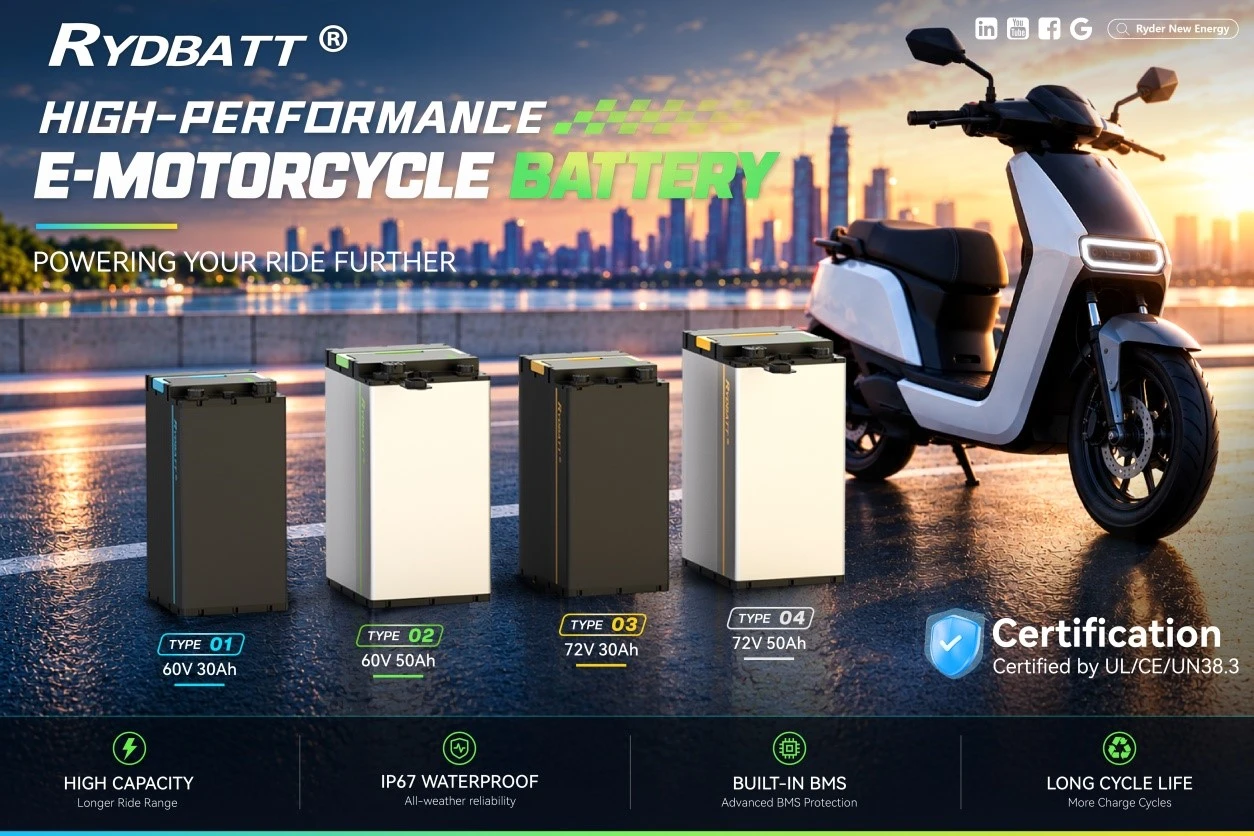
RYDBATT designed a custom electric motorcycle lithium battery pack based on the customer's vehicle system, controller current, target riding range, installation space and fleet operating conditions.
Cell Selection
RYDBATT selected grade-A lithium iron phosphate (LiFePO4 / LFP) cells for the whole published RYDM range, chosen for electric motorcycle traction duty where thermal stability, cycle life and daily deep cycling matter more than absolute cell weight. Cell configurations run from 20S6P at 60V 30Ah (5.0Ah cells, 6 in parallel) through 20S2P at 60V 50Ah, 23S2P at 72V 30Ah and 23S1P at 72V 50Ah, with 20S9P at 72V 22Ah on the 18650-based platform. Charge cut-off is set at 3.65V per cell and discharge cut-off at 2.80V per cell, so the pack works with standard 72V controllers.
Smart BMS Design
The battery pack used a smart BMS with protection functions including overcharge protection, over-discharge protection, overcurrent protection, short-circuit protection, temperature monitoring and cell balancing. State-of-charge accuracy is held within ±3%, with continuous and peak limits matched to the controller rating and the target riding load.
For fleet operation, CAN and RS485 communication ship as standard on the 60V and 72V platforms, with Bluetooth monitoring for smartphone or dashboard use and GPS tracking available as an option. Data available to the controller typically includes state of charge, pack voltage, current, cell voltage, temperature and fault flags.
Heavy-Duty Sealed Housing
RYDBATT designed a sealed aluminium alloy case to improve structural strength during delivery use while keeping the pack light. The RYDM6030 weighs 15 kg for 1800Wh - roughly 120Wh/kg at pack level - against about 38 kg for a comparable 72V 60Ah lead-acid pack. Casing dimensions, mounting position, connector direction and IP67 sealing were all taken from the customer's battery compartment.
Connector and Charger Matching
Charging and discharging connectors were customized according to the customer's electric motorcycle system - pin assignment, cable length and gauge are matched to the vehicle-side interface, and the published platform uses an M23 2+1+5-core female socket with dust cap. RYDBATT also matched the charger specification with the battery voltage, BMS setting and charging current requirements.
Project-Based Customization
The final battery solution supported:
- 48V / 60V / 72V / 73V voltage options
- 20Ah–50Ah standard range from 1440Wh to 3600Wh, project-based capacity design
- Smart BMS protection with cell balancing and ±3% SOC accuracy
- CAN and RS485 standard, Bluetooth monitoring and optional GPS tracking
- Sealed aluminium alloy, engineering plastic or stainless steel casing
- Connector, harness and charging current customization, charger matching
- Label, logo, barcode, user manual and packaging customization
- OEM/ODM production for fleet and distributor projects, with UL, CE and CB available
Testing and Validation
Before sample approval and mass production, RYDBATT carried out a complete testing and validation process to verify battery performance, safety and batch consistency. Published packs are rated for 1,500–2,000 cycles at 80% depth of discharge on the NCM platform and roughly 2,000+ cycles on the LFP platform, with a 2-year or 1,500-cycle warranty whichever comes first.
|
Testing Item |
Purpose |
|
Capacity Test |
Verify real battery capacity and energy output (rated capacity quoted at 0.2C, 25 ±2°C) |
|
Charge and Discharge Test |
Check charging behaviour, discharge stability and working performance; charge cut-off 4.10V per cell, |
|
Aging Test |
Screen unstable battery packs before shipment |
|
BMS Protection Test |
Verify overcharge, over-discharge, overcurrent, short-circuit and temperature protection |
|
High-Current Discharge Test |
Check output stability under delivery motorcycle load conditions; 80A continuous with 90A ±9A peak |
|
Connector Polarity Test |
Confirm correct charging and discharging interface connection |
|
Voltage and Internal Resistance Check |
Verify cell consistency before and after assembly |
|
Environmental and Mechanical Test |
Validate -20°C to +60°C discharge and 0°C to +55°C charging band, plus vibration and drop testing |
|
Appearance Inspection |
Check casing, label, terminal, screws and surface condition |
|
Packing Inspection |
Confirm protective packing, carton mark and shipment readiness |
Production and QC Workflow
01
Project Requirement Review
02
Cell Selection and Incoming Inspection
03
Cell Sorting and Matching
04
Module Assembly
05
BMS and Connector Installation
06
Insulation and Structural Protection
07
Charge and Discharge Test
08
Aging and Stability Test
09
Final QC Inspection
10
Labeling and Packing
11
Shipment Release
Result
After sample testing and customer-side vehicle verification, the electric motorcycle battery pack passed the required performance checks and was approved for mass production.
The customer received a more stable lithium battery solution for delivery motorcycles and logistics fleet use. Compared with the previous lead-acid supply, the new battery pack helped improve discharge stability, reduce after-sales complaints and support better product consistency for fleet customers - at roughly half the pack weight and around four to six times the cycle life class.
Project Results
✓Samples passed customer testing
✓Battery pack entered batch production
✓Stable delivery for B2B fleet application
✓After-sales complaints were reduced compared with previous supply
✓Customer placed repeat orders after initial shipment
✓Product line expanded from one battery configuration to multiple voltage, capacity and housing options
✓The customer started promoting the battery for delivery motorcycles, electric scooters and logistics fleet projects
Why This Project Matters
Electric motorcycle batteries for delivery and logistics use must perform under more demanding conditions than ordinary consumer batteries. Riders may charge and discharge the battery every day, ride in outdoor environments, carry heavier loads and require stable output during long working hours. The published comparison is blunt about the chemistry gap: lead-acid gives 300–500 cycles, Li-ion 800–2,000, and LiFePO4 2,000+.
For this type of B2B project, the key is not only battery capacity. The battery must match the vehicle system, controller current, charger, connector, casing space, waterproof requirement and fleet management needs. Voltage alone is not a specification: 48V suits smaller motorcycles and scooters, 60V is a middle tier for moderate performance and range, and 72V is the high-performance platform for faster speeds and longer rides.
RYDBATT's project-based battery development helped the customer build a more reliable electric motorcycle battery product line for high-frequency urban mobility use.
Product Line: Published Electric Motorcycle Battery Range
The project draws on a product line that is already in production and published on the RYDBATT electric motorcycle battery category. The models below are the platforms most often specified for two-wheel and light-vehicle duty, with the figures taken directly from the published technical specifications.
Source: ryderelectronics.com/electric-motorcycle-battery/ - specifications as published at time of writing.
|
Model |
Voltage |
Capacity |
Energy |
Config |
Cont. Dis. |
IP |
Weight |
Key position |
|
RYDM6030 |
60 V |
30 Ah |
1800 Wh |
20S6P (5.0Ah cells) |
60 A |
IP67 |
15 kg |
Compact all-rounder for e-moto, scooters and delivery; CAN / RS485 / Bluetooth standard |
|
RYDM6050 |
60 V |
50 Ah |
3000 Wh |
20S2P (25Ah cells) |
100 A |
IP67 |
24 kg |
High-torque e-moto, delivery fleets and cargo tricycles; 50 A continuous charging |
|
RYDM7230 |
72 V |
30 Ah |
2160 Wh |
23S2P (LFP) |
60 A |
IP67 |
18.0 kg |
LFP chemistry for long cycle life and thermal stability; CAN / RS485 / GPS standard |
|
RYDM7250 |
72 V |
50 Ah |
3600 Wh |
23S1P (LFP) |
100 A |
IP67 |
28 kg |
High-power LFP platform for loaded electric motorcycles |
|
72V22Ah (20S9P) |
72 V |
22 Ah nominal / 20 Ah rated |
1584 Wh nominal / 1440 Wh rated |
20S9P |
80 A |
IP67 |
- |
180 × 18650 cells, 80 A continuous discharge, 90 A ±9 A peak for 15–25 s |
|
61V40Ah (Li-21700-17S9P) |
61.2 V (71.0 V charge limit) |
39.6 Ah |
2.42 kWh |
17S9P, 153×21700 cells |
50 A |
IP67 |
17 kg |
Cylindrical Li-ion 21700 cells, 4200mAh grade, with RS485 telemetry, aging test and metal housing; for industrial AGV and solar / wind storage duty |
|
46.8V 20.8Ah |
46.8 V |
20.8 Ah |
- |
13S8P |
40 A |
IP67 |
- |
104 grade-A cells; 21.1Ah typical, 20.8Ah minimum capacity |
|
72V20Ah (20S4P) |
72 V |
20 Ah |
1440 Wh |
20S4P |
- |
IP67 |
10 kg |
Compact 80-cell pack with three-tier PCM protection |
|
72V32Ah (20S8P) |
72 V |
32 Ah |
- |
20S8P |
- |
IP67 |
- |
Rugged platform for EVs, renewable energy storage and heavy machinery |
|
72V27.5Ah (20S6P) |
72 V |
27.5 Ah |
- |
20S6P |
- |
IP67 |
- |
Mid-capacity option for e-motorcycles, e-bikes and industrial machinery |
|
72V40Ah (20S8P) |
72 V |
40 Ah |
- |
20S8P |
- |
IP67 |
- |
High-performance option for acceleration and extended range |
|
48V20.8Ah (13S8P) |
48 V |
20.8 Ah |
- |
13S8P |
- |
IP67 |
- |
In-house manufacture from cell grading and welding to BMS firmware |
Delivered Pack - Full Technical Specification
The pack delivered for this project follows the RYDM6030 platform, which is the configuration most often specified for delivery and logistics duty where weight, range and charging turnaround all matter at once.
|
Parameter |
Specification |
|
Model |
RYDM6030 |
|
Brand |
RYDBATT |
|
Battery Type |
Lithium iron phosphate (LiFePO4 / LFP) rechargeable battery pack |
|
Nominal Voltage |
60 V |
|
Nominal Capacity |
30 Ah |
|
Rated Energy |
1800 Wh |
|
Cell Configuration |
20S6P (5.0Ah cells, 20 series × 6 parallel) |
|
Max. Continuous Discharging Current |
60 A |
|
Max. Continuous Charging Current |
30 A |
|
Waterproof Grade |
IP67 |
|
Net Weight |
15 kg |
|
Dimensions (L × W × H) |
184 × 156 × 320 mm |
|
Enclosure |
Sealed aluminium alloy case |
|
BMS Protection |
Over-charge / over-discharge / over-current / short-circuit / temperature, with cell balancing |
|
Communication |
CAN (standard) · RS485 (standard) · Bluetooth (standard) |
|
Telematics Option |
GPS tracking (optional) |
|
Cell Chemistry |
Grade-A LFP cells |
|
Cycle Life |
2,000+ cycles at 80% depth of discharge |
|
Warranty |
2 years or 1,500 cycles, whichever comes first |
|
Certification |
CE · UN38.3 · MSDS (UL available on project request) |
|
OEM / ODM |
Accepted - voltage, capacity, case, connector, harness, protocol |
Chemistry Upgrade Path - 72V Lead-Acid vs RYDBATT 72V 30Ah LFP
The published RYDM7230 comparison against a typical 72V 60Ah lead-acid pack is the clearest way to size the upgrade for a fleet buyer. Note that capacity is not directly comparable and the charger must change with the chemistry.
|
Item |
72V 60Ah lead-acid |
RYDBATT RYDM7230 (72V 30Ah LFP) |
Change |
|
Nominal voltage |
72V |
72V |
Direct match |
|
Chemistry |
Lead-acid |
LFP (LiFePO4) |
Chemistry change |
|
Capacity |
60Ah |
30Ah |
Different - check controller |
|
Weight |
~38 kg (typical class) |
18.0 kg |
Roughly half |
|
Rated energy |
~4.3 kWh rated (usable ~2.2 kWh at 50% DoD) |
2160–2208 Wh |
Comparable usable energy per charge |
|
Service life |
300–500 cycles |
2,000+ cycles (LFP, 80% DoD) |
4–7× class |
|
Maintenance |
Electrolyte top-up, terminal check |
None |
Eliminated |
|
Cold behaviour |
Capacity drops sharply below freezing |
Rated to -20°C, reduced capacity |
Wider band |
|
Electronics |
Lead-acid charger required |
LFP charger required |
Charger must change |
|
Monitoring |
None |
CAN / RS485 / GPS |
Telemetry added |
Application Fit
The platform is engineered for two-wheel and light-vehicle platforms that need more than a small commuter pack. Each duty below is matched to a specific published attribute rather than a generic claim.
|
Application |
Why it fits |
|
Electric motorcycles (e-moto) |
60A continuous discharge covers urban riding, highway cruising and hill terrain |
|
Electric scooters / electric mopeds |
184 × 156 × 320 mm footprint fits common step-through frames and battery boxes |
|
Electric delivery motorcycles |
30A fast charging minimises downtime between shifts |
|
Electric tricycles and cargo e-trikes |
15 kg pack and 1800Wh energy balance load capacity and vehicle weight |
|
E-bikes and light e-moto EV platforms |
CAN / RS485 integration lets the controller manage charge and state of charge |
|
Battery swap and fleet operations |
Standardised dimensions, protocol and monitoring simplify pack rotation |
|
Low-speed electric vehicles and mobility aids |
IP67 sealed enclosure for outdoor and rough-road use |
|
Telecom, solar and wind storage (61V platform) |
21700 LFP cells with wide-temperature operation and configurable capacity |
Voltage Platform Selection
Voltage is the first decision on any electric motorcycle project, and it is a performance decision rather than a compatibility one. All three platforms below are in production.
|
Voltage |
Typical fit |
Published options in this range |
|
48V |
Suitable for smaller motorcycles or scooters; adequate speed for short commutes |
48V 20.8Ah 13S8P |
|
60V |
A middle-tier option for moderate performance and range |
RYDM6030 (30Ah / 1800Wh), RYDM6050 (50Ah / 3000Wh) |
|
72V |
High-performance motorcycles use this voltage for faster speeds and longer rides |
72V 20Ah / 22Ah / 27.5Ah / 30Ah / 32Ah / 40Ah / 50Ah, plus 61V wide-temp LFP |
Battery Chemistry Selection
Three chemistries are relevant to electric motorcycles. The published cycle-life figures explain most of the total-cost argument for a B2B fleet buyer.
|
Chemistry |
Published cycle life |
Strength |
Trade-off |
|
Lead-Acid |
300–500 cycles |
Cost-effective, widely available and well understood |
Heavy, requires electrolyte top-up and terminal checks, short service life |
|
Lithium-Ion (Li-ion) |
800–2,000 cycles |
High energy density and fast charging; the standard choice in modern electric vehicles |
Higher cell cost, requires a matched charger and BMS |
|
Lithium Iron Phosphate (LiFePO4) |
2,000+ cycles |
Robust thermal and chemical stability, long service life, fewer toxic materials |
Heavier per unit energy than NCM, needs a dedicated LFP charger |
Customisation Envelope
The published platform is already open for adaptation, so a project-specific pack usually changes dimensions, interface or protocol rather than the whole product.
|
Customisable Item |
Typical Range / Option |
|
Nominal voltage |
48V / 60V / 72V |
|
Capacity |
10Ah – 200Ah |
|
Cell configuration |
20S2P and other series-parallel layouts |
|
Case |
Aluminium alloy, engineering plastic or stainless steel; custom dimensions and colour |
|
Connector & harness |
Pin assignment, cable length and gauge to your CAD drawing |
|
Communication protocol |
CAN, RS485, UART; protocol document supplied at sampling stage |
|
Monitoring |
Bluetooth app, SOC display, GPS tracking, 4G option |
|
Branding |
Private label, laser logo, custom colour, custom manual and packaging |
|
Certification |
Apply UL, EN 15194, IEC 62133 or project-specific certification |
Commercial Terms
The following terms are the published defaults for the electric motorcycle battery category and are confirmed again in the quotation for each project.
|
Item |
Published Term |
|
OEM / Private Label |
Accepted - customer logo, label, packaging and documentation on request |
|
Payment Terms |
T/T 30% as deposit, and 70% before delivery. Product and packing photos are shown before the balance is paid. |
|
Delivery Terms |
EXW, FOB, CIF, DDP and other incoterms on request |
|
Lead Time |
5–25 workdays after receiving advance payment; specific timing depends on the items and order quantity |
|
Sample Policy |
Sample or prototype evaluation can be arranged before pilot and mass production |
|
Warranty |
2 years or 1,500 cycles, whichever comes first, on published NCM platforms |