


Customer Case Study
Drone Battery Customization Project
Custom High-Energy Battery Pack for Agricultural Spraying Drones and Heavy-Lift UAVs
RYDBATT developed a custom drone battery pack for a B2B UAV customer serving agricultural spraying drone and heavy-lift UAV applications. The project required high energy density, stable high-current discharge, safe charging, lightweight structure and reliable batch consistency for demanding outdoor flight missions.
This case study shows how RYDBATT helped the customer develop a customized drone battery solution from requirement review, cell selection, BMS protection and connector matching to testing validation and batch delivery.
Project Background
The customer was a professional drone system integrator and UAV equipment distributor serving the agricultural and industrial drone market.
Their main products included agricultural spraying drones, crop protection UAVs, heavy-lift drones and long-range mission platforms. These drones were used for farm spraying, payload transportation, field inspection and industrial aerial work.
- Before working with RYDBATT, the customer faced several problems with their existing drone battery supply:
- Battery weight was too high and reduced flight time and payload margin
- Discharge performance was unstable under heavy payload conditions, and voltage sag under burst load upset the flight controller
- Battery temperature increased quickly during high-current operation, which shortened service life in summer field campaigns
- Cycle life was not stable enough for daily agricultural use, where one pack is recharged several times a day
- Connector and cable layout did not match different UAV platforms, so a platform change meant a new cable harness each time
- Battery packs lacked clear batch traceability and consistent testing records for airworthiness review
- After-sales complaints increased when drones operated in hot outdoor environments, and failure diagnosis was slow
- Existing suppliers could not support flexible customization for voltage, capacity, connector and pack structure
The customer needed a drone battery manufacturer that could support project-based customization for agricultural spraying drones and heavy-lift UAVs, while maintaining stable quality for repeat orders.
Customer Requirements
|
Requirement Item |
Project Requirement |
|
Customer Type |
UAV system integrator and drone equipment distributor |
|
Market |
Agricultural drone and industrial UAV market |
|
Application |
Agricultural spraying drones, crop protection UAVs, heavy-lift drones and long-range mission platforms |
|
Voltage Platform |
Customized voltage based on UAV system, such as 6S / 12S / 14S / project-based configuration |
|
Capacity Range |
Customized high-capacity battery pack according to flight time and payload requirement; 881 Wh on the |
|
Battery Chemistry |
Grade-A high-energy-density Li-ion cells; 18650 and 21700 formats with high-rate options, project-based configuration |
|
Battery Format |
12S2P reference layout with 18650 and 21700 cell formats; custom configurations from 3S to 14S, 1P to 8P |
|
BMS / Protection |
Smart BMS with two-tier cell over-charge, staged over-current, deep-discharge lock and CANopen telemetry |
|
Discharge Requirement |
30 A continuous with a 130 A 10-second pulse for takeoff climb, gust compensation and heavy payload operation |
|
Communication |
CANopen at 125 kbit/s reporting cell voltage, temperature, state of charge and protection events |
|
Connector |
Project-based high-current connector with matching cable length, gauge and direction |
|
Cable Layout |
Customized power cable, balance cable and connector direction |
|
Size and Weight |
186.9 x 167.5 x 120.25 mm and approx. 4.1 kg with protective case on the 12S2P reference pack |
|
Certification |
UN 38.3, MSDS and project-based shipping documents, with in-house UN 38.3 / UL test protocols |
|
Working Environment |
Outdoor farm operation, high-load flight, repeated charging and daily UAV missions; |
|
Lead Time |
Engineering samples in 7 days, bulk production in 25-30 days, custom packs from 50 pcs |
RYDBATT Solution
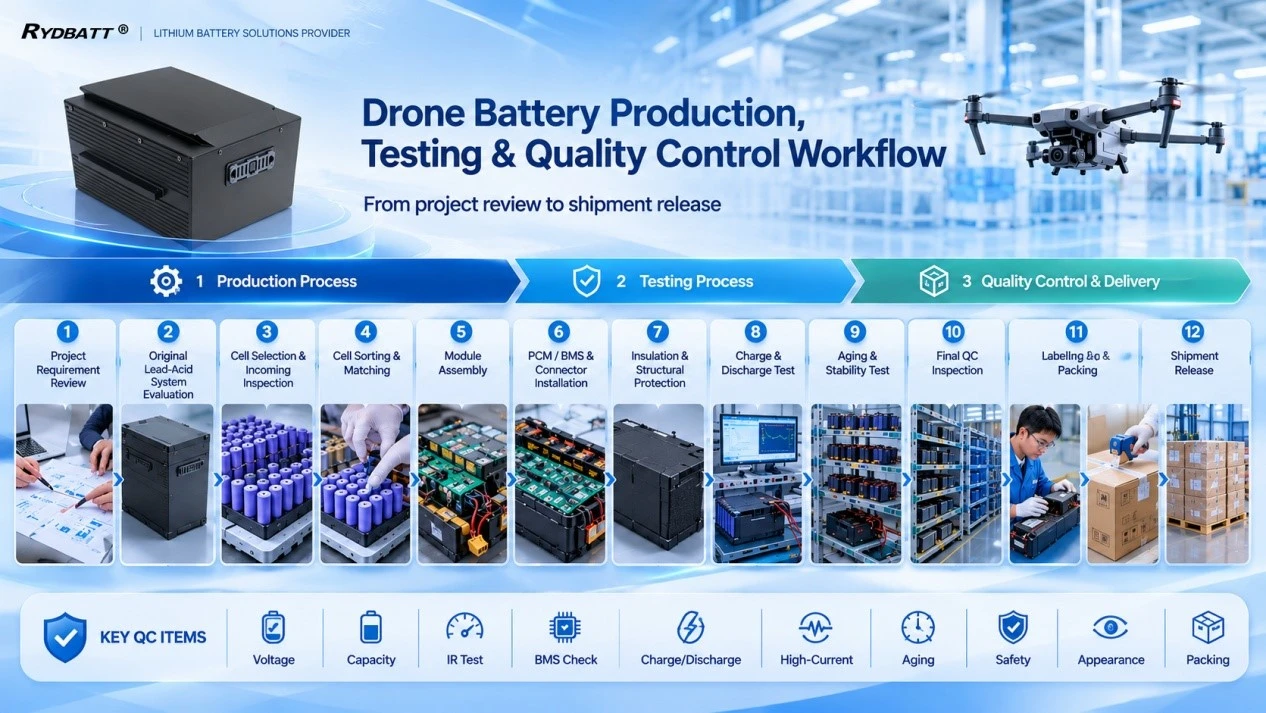
RYDBATT designed a custom drone battery pack based on the customer's UAV platform, voltage requirement, target flight time, payload weight, discharge current, installation space and outdoor working environment.
Cell Selection
RYDBATT selected high-performance drone battery cells suitable for high-discharge UAV applications. On the reference 12S2P platform the pack is built on grade-A high-energy-density Li-ion cells in a 12-series 2-parallel layout, and the high-drain 21700 range is available from 6S1P up to 14S4P for smaller airframes.
The cell configuration was designed to support stable output during takeoff, spraying, climbing and heavy-lift operation. The reference pack delivers 881 Wh at about 215 Wh/kg pack-level, so roughly 30% more flight energy per kilogram than a typical pack of the same class. For agricultural drones, the battery pack needed to support repeated daily charging and discharging. For heavy-lift UAVs, the battery needed stronger discharge capability and better energy-to-weight balance, which is why 30 A continuous is paired with a 130 A 10-second pulse.
BMS / PCM Protection Design
RYDBATT matched the protection system according to the battery chemistry, voltage platform, discharge current and charging method.
The protection design is a dual-layer architecture. The microcontroller layer covers per-cell over-charge at 4.23 V and 4.265 V with release at 4.10 V, a pack-level cut-off at 50.76 V, staged over-current limits with charge steps at 30 A and 60 A and discharge alerts at 60 A over 5 minutes and 145 A over 10 seconds, a deep-discharge lock at 2.8 V with wake-on-charger only, full thermal coverage, +/-4 kV contact and +/-8 kV air ESD immunity, and auto-sleep at 300-500 microamp idle. A second hardware layer adds 2 x 30 A charge-path fuses and 5 x 40 A discharge-path fuses, so protection does not depend on one measurement or on the processor staying awake.
For high-discharge drone batteries, RYDBATT focused on discharge stability, temperature control, connector safety and cell consistency to reduce failure risk during flight. Pack impedance is held at 60 mΩ or below on a fresh pack, which keeps voltage sag under 5% from 100% down to 5% state of charge, and cell balancing opens when any cell reaches 4.0 V and the cell-to-cell delta reaches 30 mV or more, and closes when the delta falls back to 10 mV, balancing at about 84 mA per cell.
Lightweight Pack Structure
RYDBATT designed the battery pack structure based on the drone's battery compartment, mounting method and weight limit. The structure was optimized to reduce unnecessary weight while maintaining insulation, mechanical protection and safe wiring layout.
The pack could be customized with protective film, heat-shrink structure, reinforced insulation, anti-vibration pads, fixing straps, label position and battery handle design according to the UAV platform. On the reference 12S2P pack the envelope is 186.9 x 167.5 x 120.25 mm within a 1.0 mm tolerance and the complete pack weighs about 4.1 kg including the protective case.
Connector and Cable Matching
RYDBATT customized the connector and cable layout according to the customer's drone power system.
Connector options included a project-based high-current connector, an aviation-style plug or a project-specific locking connector. Cable length, cable diameter, connector angle and balance cable layout could be adjusted to fit the drone frame and battery bay.
The goal was to improve installation efficiency, reduce wiring stress and support safer high-current discharge during flight.
Project-Based Customization
The final drone battery solution supported:
- Customized voltage platform
- Customized capacity and pack size
- Grade-A high-energy-density Li-ion cell options in 18650 and 21700 formats
- Lightweight battery pack structure
- High-current connector customization
- Power cable and balance cable customization
- Temperature monitoring option
- Protective film and insulation structure
- Custom label, warning sticker and batch code
- OEM/ODM production for drone brands and UAV distributors
Testing and Validation
Before sample approval and batch production, RYDBATT carried out a full drone battery testing and validation process to verify performance, safety and consistency.
|
Testing Item |
Purpose |
|
Capacity Test |
Verify real battery capacity and energy output; the reference pack is rated 21.6 Ah typical and 20.5 Ah minimum |
|
Charge and Discharge Test |
Check charging behavior, discharge stability and voltage curve at the 50.4 V charge voltage and 30 V pack cut-off |
|
High-Current Discharge Test |
Verify output stability under takeoff, |
|
Aging Test |
Screen unstable battery packs before shipment; |
|
BMS / PCM Protection Test |
Verify the dual-layer protection: per-cell over-charge at 4.23 / 4.265 V, staged over-current, |
|
Voltage and Internal Resistance Test |
Confirm cell consistency before and after assembly, with pack impedance held at 60 mΩ or below |
|
Temperature Rise Test |
Check heat behavior during high-current discharge inside the charge 0-50 °C and discharge -20 to 60 °C window |
|
Connector and Polarity Test |
Confirm correct connector direction, polarity and cable connection |
|
Appearance Inspection |
Check film, label, cable, connector, insulation and surface condition |
|
Packing Inspection |
Confirm protective packaging, carton marks and lithium battery shipment readiness; |
Production and QC Workflow
01
Project Requirement Review
02
UAV Platform and Battery Compartment Evaluation
03
Cell Selection and Incoming Inspection
04
Cell Sorting and Matching
05
Pack Assembly
06
PCM / BMS and Connector Installation
07
Insulation and Structural Protection
08
Charge and Discharge Test
09
High-Current Discharge Verification
10
Aging and Stability Test
11
Final QC Inspection
12
Labeling and Packing
13
Shipment Release
Result
After sample testing and customer-side flight verification, the custom drone battery pack passed the required performance checks and was approved for batch production.
The customer used the customized battery solution for agricultural spraying drones and heavy-lift UAV projects. Compared with their previous battery supply, the new solution helped improve discharge stability, reduce battery-related after-sales issues and support better product consistency across repeated orders.
Project Results
✓Samples passed customer flight testing
✓Battery pack entered batch production
✓Bulk order was delivered successfully
✓High-current discharge performance became more stable
✓Battery-related after-sales complaints were reduced
✓Customer placed repeat orders after the initial shipment
✓Product line expanded from one UAV battery model to multiple voltage and capacity configurations
✓The customer started promoting the battery solution for agricultural spraying drones, crop protection drones and heavy-lift UAV platforms
Why This Project Matters
Drone battery customization is not only about capacity. For agricultural spraying drones and heavy-lift UAVs, the battery must balance energy density, discharge rate, weight, temperature control, connector safety and flight stability.
A poor battery design can reduce flight time, increase heat, damage connectors, shorten cycle life and create safety risks during high-load operation. A successful drone battery project must match the UAV voltage platform, payload, discharge current, installation space, cable direction, charging system and working environment.
RYDBATT's project-based design helped the customer build a more reliable drone battery product line for professional UAV applications.
Need a Custom Drone Battery Solution?
RYDBATT supports project-based battery design for agricultural spraying drones, heavy-lift UAVs and professional drone platforms. Share your voltage, capacity, discharge current, connector and weight requirements - we will develop a battery solution matched to your UAV system.