


Customer Case Study
Consumer & Household Device Battery Project
Custom Li-ion Battery Packs for Cleaning Robots, Smart Home Devices and Portable Appliances
RYDBATT developed a custom Li-ion battery pack family for a B2B customer serving robot vacuum brands, pool cleaner manufacturers, power tool and portable appliance makers. The project required stable voltage output, slim housings that fit an existing chassis envelope, smart BMS protection, thermal monitoring, dock-and-charger compatibility and reliable operation across daily charge-discharge cycles in indoor and outdoor environments.
This case study shows how RYDBATT helped the customer develop a consumer lithium battery solution from requirement review, cell selection, protection circuit design, slim housing development and connector matching to testing validation and batch delivery.
Project Background
The customer was a consumer appliance brand and OEM supplier serving the household cleaning and portable device market.
Their products were used in robot vacuum cleaners, automatic pool cleaners, handheld power tools, facial cleansing brushes, smart home devices and portable medical devices.
Before working with RYDBATT, the customer faced several problems with their previous battery supply:
- NiMH and pouch packs from other suppliers delivered inconsistent runtime between production batches
- Battery runtime was unstable across the model range, so a single SKU could not cover several chassis positions
- Voltage sagged under continuous load, which shortened cleaning cycles and triggered dock retries
- Pack thickness and connector placement did not match the existing chassis drawings
- Thermal management was insufficient for appliances whose motor housing sits close to the pack
- The BMS message list did not match the appliance mainboard, so fuel-gauge data was unreliable
- Previous packs carried no cycle count or fault log, so field failures were hard to diagnose
- The customer needed a longer-life lithium platform that covered cleaning, tool and smart-home models from one supplier
The customer wanted a custom Li-ion battery platform that could support longer runtime, a slim enclosure that fits the existing chassis, reliable protection and faster root-cause diagnosis for cleaning robots, pool cleaners and portable appliances.
Customer Requirements
|
Requirement Item |
Project Requirement |
|
Customer Type |
Appliance brand owner or OEM supplier for household cleaning and portable devices |
|
Market |
Consumer electronics, home appliances, smart home and portable medical device market |
|
Application |
Robot vacuum cleaners, automatic pool cleaners, handheld power tools, |
|
Voltage Platform |
14.4V / 21.6V / 22.2V / 25.2V (4S-7S), or project-based voltage |
|
Capacity Range |
2,000mAh to 8,000mAh, configured by parallel group count against the runtime target |
|
Battery Chemistry |
Li-ion, grade-A high-energy-density cells; 500-1,000 cycles against 300-500 for nickel-metal hydride |
|
Cell Type |
18650 (18 x 65 mm), 21700 (21 x 70 mm) and pouch cells (3-15 mm thick), all produced in-house |
|
BMS |
Smart BMS with overcharge, over-discharge, overcurrent, short-circuit, temperature |
|
Communication |
SMBus / I2C / UART for dock handshake and fuel-gauge data; CAN 2.0B or UART 3.3V |
|
Housing |
Steel shell, aluminium alloy enclosure, sealed polymer housing or slim pouch format, |
|
Interface |
Customized connector type and cable length matched to the appliance mainboard |
|
Size |
Customized against the battery bay drawings; compact formats down to approximately |
|
Charger Matching |
Charger and charging-dock matching with per-pack current limits: |
|
Certification |
UL 2271, IEC 62133, UN38.3, CE and RoHS depending on project and destination market |
|
Working Environment |
Indoor household use, damp pool environments, repeated daily charging, portable |
|
Lead Time |
Sample development first, then batch production after customer-side testing; |
RYDBATT Solution
RYDBATT designed a custom Li-ion battery pack based on the customer's appliance platform, motor power, target runtime, battery bay size, thickness limit, charging dock and operating environment.
Cell Selection
RYDBATT selected grade-A Li-ion cells suitable for consumer appliance applications, produced in three formats in-house: 18650 at 18 x 65 mm, 21700 at 21 x 70 mm and pouch cells from 3 to 15 mm thick.
Cell format and configuration were selected against the chassis envelope rather than from a catalogue, because a robot vacuum or a handheld tool has no room for a cell that is only 2 mm too thick. Pouch formats are used where thickness is the binding constraint, 18650 where cost and maturity matter, and 21700 where capacity and discharge rate drive the design. Parallel-group configuration sets the runtime target from 2,000 to 8,000 mAh across the 14.4V, 21.6V and 25.2V platforms.
Compared with nickel-metal hydride packs, the Li-ion platform removes the memory effect, doubles usable cycle life from 300-500 cycles to 500-1,000, and supports high-cycle versions reaching 1,000+ cycles for programmes that back the appliance with a three-year warranty.
Smart BMS Design
The battery pack used an integrated protection circuit to manage safety, performance and long-term stability.
Protection functions include overcharge detection at 4.25 +/- 0.03 V with release at 4.15 +/- 0.05 V, over-discharge detection at 2.80 +/- 0.05 V with release at 3.00 +/- 0.05 V, two-level over-current protection, short-circuit detection above 70 A with a 400 +/- 50 microsecond response, and temperature protection with separate charge and discharge thresholds. Cell balancing opens at 4.125 +/- 0.050 V and runs at 30-50 mA.
For appliance brands and OEM suppliers, SMBus, I2C or UART communication is available for dock handshakes and fuel-gauge data, while the 22.2V 13.5Ah platform runs CAN or UART at 3.3 V TTL. NTC 10K B3950 +/- 1% thermistors are fitted as standard for temperature monitoring.
Slim Housing and Terminal Assembly
RYDBATT designed the housing based on the customer's battery bay and the appliance's own thermal environment.
The structure focused on thickness, terminal safety, vibration resistance, drop durability and simple installation. Depending on the project requirement, the pack can use a steel shell, an aluminium alloy enclosure, a sealed polymer housing or a slim pouch format, with the connector type, cable length and bracket geometry matched to the appliance mainboard and charging dock.
The casing size, terminal position, bracket, label placement and mounting points are customized against the customer's battery bay drawings, and compact formats down to approximately 8 mm are achievable depending on the cell combination and the protection requirements.
Connector and Charger Matching
RYDBATT matched the charging and discharging interface according to the customer's appliance platform, dock and charger requirement.
Connector options include the 3.96 mm pitch two-pin type used on the 21.6V 5100mAh pack, the two-pin type with an integrated NTC thermistor, and project-based custom connectors with the cable length set to reach the appliance mainboard and charging dock.
The charger was matched according to battery voltage, capacity, charging current and the protection setting, so the dock handshakes with the pack rather than applying a blanket profile. On the published 21.6V 5100mAh pack the maximum continuous discharge current is 5 A and the maximum charge current is 2.6 A; on the 22.2V 13.5Ah pack the limits are 25 A continuous discharge and 10 A charge.
Project-Based Customization
The final consumer Li-ion battery solution supported:
- 14.4V / 21.6V / 22.2V / 25.2V consumer platforms, project-based voltage available
- Customized capacity from 2,000 to 8,000 mAh set by parallel group count
- Grade-A Li-ion cells in 18650, 21700 and pouch formats, all produced in-house
- Smart BMS protection with NTC temperature monitoring and cell balancing
- SMBus / I2C / UART communication for dock handshake and fuel-gauge data
- Sealed housing structure with connector orientation matched to the dock
- Steel shell, aluminium alloy enclosure or slim pouch housing to the thickness limit
- Customized terminals, connectors and cable lengths matched to the mainboard
- Dedicated charger and charging-dock matching with per-pack current limits
- Custom label, warning sticker, user manual, colour box and batch code
- OEM/ODM production for appliance brands, distributors and repair markets
Testing and Validation
Before sample approval and mass production, RYDBATT completed a full testing process to verify battery performance, safety, environmental reliability and shipment quality. Every pack is serialised back to the cell lot, the firmware revision and the test record.
|
Testing Item |
Purpose |
|
Capacity Test |
Verify real battery capacity and usable energy across the parallel-group configuration |
|
Charge and Discharge Test |
Check charging behaviour, discharge stability and voltage output across the 14.4V, 21.6V |
|
Aging Test |
Screen unstable battery packs before shipment; 300-600 cycles at 0.2C with 80% capacity retention |
|
BMS Protection Test |
Verify overcharge at 4.25 V, over-discharge at 2.80 V, two-level over-current, short-circuit above |
|
High-Current Discharge Test |
Check output stability for tool motor start-up and continuous load; 25 A continuous on the |
|
Voltage and Internal Resistance Test |
Confirm cell consistency before and after assembly, |
|
Communication Test |
Verify SMBus, I2C or UART reporting with the appliance mainboard for fuel-gauge |
|
Connector and Polarity Test |
Confirm terminal position, connector safety and polarity against the appliance drawing |
|
Insulation and Safety Test |
Reduce electrical safety risk in damp pool and bathroom environments |
|
Enclosure Sealing Inspection |
Check housing sealing, terminal protection and water resistance for pool cleaner models |
|
Appearance Inspection |
Check case surface, terminals, screws, label, barcode and surface condition |
|
Packing Inspection |
Confirm protective packaging, carton marks and lithium battery transport compliance, |
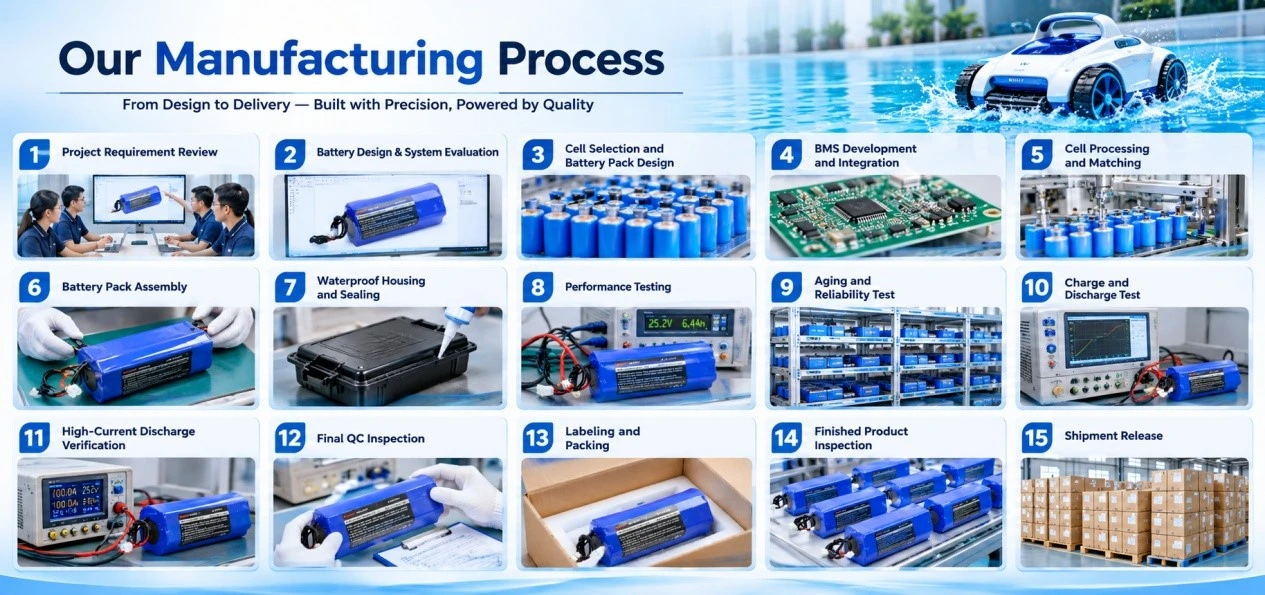
Production and QC Workflow
01
Project Requirement Review
02
Device Application Evaluation
03
Battery Compartment and Installation Review
04
Cell Selection and Incoming Inspection
05
Cell Sorting and Matching
06
Module Assembly
07
Smart BMS and Harness Installation
08
Slim Housing and Terminal Assembly
09
Connector and Charger Matching
10
Charge and Discharge Test
11
High-Current Discharge Verification
12
Aging and Stability Test
13
Final QC Inspection
14
Labeling and Packing
15
Shipment Release
Result
After sample testing and customer-side installation verification, the consumer Li-ion battery pack passed the required performance checks and was approved for batch production.
The customer used the customised lithium battery solution to upgrade their household device product line for robot vacuums, pool cleaners, power tools and smart home products. Compared with their previous nickel-metal hydride or unstable lithium supply, the new platform delivered 500-1,000 cycles against 300-500, removed the memory effect that shortened usable runtime, and gave the appliance mainboard a reliable fuel-gauge and temperature feed through SMBus, I2C or UART.
Project Results
✓Samples passed customer testing
✓Battery pack entered batch production
✓Bulk order was delivered successfully
✓Runtime and voltage stability improved
✓Battery maintenance requirements were reduced
✓Reliability improved across damp pool and everyday household use
✓After-sales complaints were reduced compared with previous supply
✓Customer placed repeat orders after the initial shipment
✓Product line expanded from one battery model to the 14.4V, 21.6V and 25.2V platforms in multiple capacities
✓The customer started promoting the battery solution for robot vacuums, pool cleaners, power tools and smart home devices
Why This Project Matters
Consumer and household battery projects are different from standard lithium battery projects. The battery must not only provide voltage and capacity, but also fit a fixed chassis envelope, survive daily charge-discharge cycles, match the charging dock's handshake, carry the mainboard's fuel-gauge protocol and stay within a cost structure that works at retail volume.
For robot vacuums, pool cleaners and handheld tools, poor battery design causes unstable runtime, dock charging failures, connector mismatch, swollen packs in sealed housings and higher after-sales cost. A 2 mm thickness difference can stop an entire model from shipping.
A successful consumer battery project must match the appliance platform, motor power, battery bay, thickness limit, terminal layout, charger and dock, communication protocol and the real operating environment. RYDBATT returns a pack proposal and a cell recommendation within 48 hours of receiving the enclosure drawings.
RYDBATT's project-based battery design helped the customer build a more reliable Li-ion battery product line for long-term B2B distribution, with the same 14.4V, 21.6V and 25.2V platforms, the same protection set and the same enclosure approach available to every programme in this category.
Need a Custom Consumer & Household Device Battery Solution?
RYDBATT supports project-based Li-ion battery design for robot vacuums, pool cleaners, power tools, smart home devices and portable appliances. Share your voltage, capacity, thickness, terminal, connector and charger requirements, and we will develop a battery solution matched to your appliance, with white-label packaging available from 500 pcs.