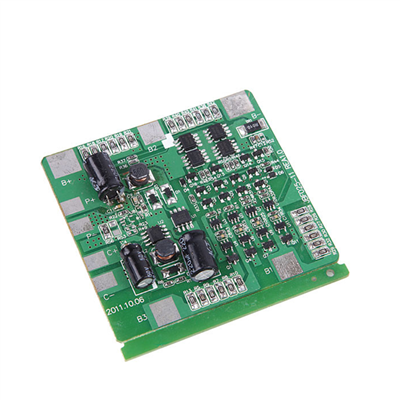

As a provider of 10S Lithium Battery BMS, I'm often asked about the available charging modes of these systems. In this blog post, I'll delve into the different charging modes, their advantages, and how they can be optimized for various applications.
Constant - Current Charging
Constant - current (CC) charging is one of the most fundamental charging modes for 10S Lithium Battery BMS. In this mode, a fixed current is supplied to the battery pack throughout the initial stage of charging. The BMS ensures that the charging current remains stable, regardless of the battery's state - of - charge (SOC).
The main advantage of CC charging is its simplicity and efficiency in quickly increasing the battery's SOC. When the battery is at a low SOC, a high constant current can be applied without causing damage. This mode is especially useful for applications where rapid charging is required, such as in electric vehicles or high - power portable devices.
However, there are limitations. If CC charging is continued until the battery is fully charged, it can lead to overcharging, which is extremely dangerous for lithium batteries. Overcharging can cause thermal runaway, electrolyte decomposition, and even explosion. Therefore, the CC charging phase must be followed by another charging mode.
Constant - Voltage Charging
After the CC charging phase, the 10S Lithium Battery BMS switches to constant - voltage (CV) charging. In CV charging, the BMS maintains a constant voltage across the battery pack while allowing the charging current to gradually decrease.
As the battery approaches full charge, its internal resistance increases, and the charging current naturally drops. The CV charging mode ensures that the battery is not overcharged by limiting the voltage. This mode is crucial for protecting the battery's lifespan and safety.
During CV charging, the battery cells are balanced more precisely. The BMS monitors the voltage of each cell and adjusts the charging current accordingly to ensure that all cells reach the same voltage level. This cell balancing is essential for the overall performance and longevity of the battery pack.
Trickle Charging
Trickle charging is a low - current charging mode that is used to maintain the battery at full charge. After the CV charging phase, the battery may self - discharge over time. Trickle charging provides a small, continuous current to compensate for this self - discharge and keep the battery at its optimal state.
This mode is particularly useful for applications where the battery is stored for long periods or used in standby mode. For example, in backup power systems, trickle charging ensures that the battery is always ready to provide power when needed. However, excessive trickle charging can also cause damage to the battery, so it must be carefully regulated by the BMS.
Fast Charging Modes
In recent years, there has been a growing demand for fast charging solutions for lithium batteries. Some 10S Lithium Battery BMS systems support fast charging modes that combine high - current CC charging with advanced control algorithms.


These fast charging modes use sophisticated temperature and voltage monitoring to ensure that the battery can withstand the high charging current without overheating or overcharging. For example, some BMS systems can adjust the charging current based on the battery's temperature in real - time. If the battery temperature rises too quickly, the BMS will reduce the charging current to prevent damage.
Fast charging is highly beneficial for electric vehicles and other high - power applications, as it significantly reduces the charging time. However, it also places more stress on the battery, which can potentially reduce its lifespan. Therefore, fast charging should be used judiciously, and the BMS must be designed to handle the increased demands.
Adaptive Charging
Adaptive charging is an intelligent charging mode that takes into account the battery's age, usage history, and current state. The 10S Lithium Battery BMS uses algorithms to analyze this data and adjust the charging parameters accordingly.
For example, as a lithium battery ages, its internal resistance increases, and its capacity decreases. An adaptive charging system will reduce the charging current and adjust the charging voltage to accommodate these changes. This mode helps to extend the battery's lifespan and maintain its performance over time.
Adaptive charging also considers the user's charging habits. If a user typically charges the battery to a certain SOC or at a specific time, the BMS can optimize the charging process based on this information. This personalized approach to charging can improve the overall user experience and the efficiency of the battery system.
Application - Specific Charging Modes
Different applications may require different charging modes. For example, in a solar energy storage system, the charging mode may need to be adjusted based on the availability of solar power. The BMS can switch between CC, CV, and trickle charging modes depending on the amount of solar energy being harvested.
In electric vehicles, the charging mode may be optimized for different driving conditions. For example, if the vehicle is used for short - distance commuting, a fast charging mode may be more suitable. On the other hand, if the vehicle is used for long - distance travel, a more balanced charging mode that prioritizes battery lifespan may be preferred.
As a 10S Lithium Battery BMS supplier, we understand the importance of providing flexible and reliable charging solutions. Our BMS systems are designed to support all the charging modes mentioned above, and we can customize the charging algorithms based on our customers' specific requirements.
If you are interested in our Lithium Bms System, 4S BMS for Li Ion Battery, or Lithium Battery Pack with Bms, please feel free to contact us for more information and to discuss your procurement needs. We are committed to providing high - quality BMS solutions that meet the highest standards of safety and performance.
References
- Smith, J. (2018). Lithium - Ion Battery Charging Technologies. Journal of Power Sources, 390, 123 - 135.
- Johnson, A. (2019). Advanced Battery Management Systems for Electric Vehicles. IEEE Transactions on Vehicular Technology, 68(5), 4567 - 4578.
- Brown, C. (2020). The Impact of Charging Modes on Lithium Battery Lifespan. Battery Research, 12(3), 78 - 89.