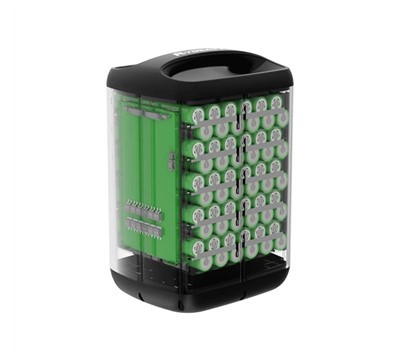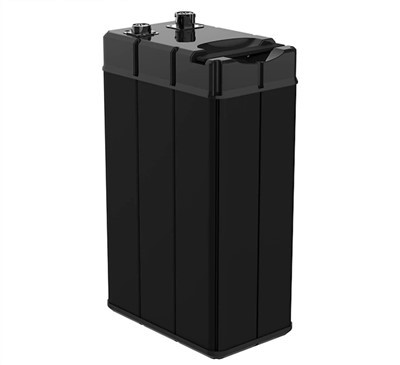


Rated Energy (nominal)
Cycle Class (condition-dependent)
Max Continuous Discharge
Pack Weight
What LFP Chemistry Actually Changes, and What It Doesn't
An LFP battery uses lithium iron phosphate as the cathode instead of the nickel-manganese-cobalt compound used in many other lithium packs, or the lead plates of a conventional lead-acid motorcycle battery. That single substitution drives nearly every difference you will notice.

Four Reasons Buyers Choose an LFP Battery Pack
Telemetry for fleet and battery swap operations
CAN and RS485 buses plus GPS telematics expose state of charge, current, cell voltage, and temperature to the vehicle controller or a swap-station cabinet.
This matters most for shared-mobility and delivery fleets, where a battery that cannot report its state is a battery that gets removed too early and returned too late.
State of charge per pack - accurate remaining-charge reporting to the platform.
Cell-level visibility - imbalance is caught before it becomes a failure.
GPS location - asset tracking across a distributed fleet.


Cycle life is where an LFP battery pack pays back the purchase price
LFP cells are typically rated in the region of 3,000 full-equivalent cycles under defined depth-of-discharge and temperature conditions. Lead-acid batteries of the same capacity class are commonly rated at 300–500 cycles.
That is not a 6x paper claim to accept blindly - it is a testable specification. Ask any LFP battery supplier for the cycle test curve, and note that the same cell can report anywhere from 2,000 to 4,000 cycles depending on depth of discharge, charge rate, and temperature.
One question settles it - ask for the curve at your actual operating depth of discharge.
Pack life is always below cell life - matching quality and balancing strategy set the ceiling.
Fleet economics follow - an LFP battery staying in service five to eight years replaces three to five lead-acid packs.
Weight reduction is verifiable arithmetic, not marketing
This pack weighs 18.0kg. A comparable 72V 60Ah lead-acid battery typically weighs in the high-30kg range. That is the checkable basis behind the "much lighter than lead acid" claim, and the single most tangible improvement for a motorcycle.
Less mass - faster acceleration and better handling.
Freed frame space - room for the motor, controller, or cargo.
Verified by scale - the one claim on this page you can check with a bathroom scale.


An LFP cell uses a lithium iron phosphate cathode with a strong olivine crystal lattice. That structure does not release oxygen at elevated temperature the way nickel-manganese-cobalt chemistries do - which is precisely the mechanism that turns an overheat into a fire.
The practical consequence for an electric motorcycle is straightforward: an LFP battery pack has a substantially lower thermal runaway risk, and it does not ignite on impact the way some pouch-cell packs can.
No protective chassis - unlike a car, a motorcycle leaves the pack exposed to impact and vibration.
Oxygen is not released - the olivine lattice has a far higher decomposition point.
Non-corrosive - no sulphuric acid to leak, no corrosive gas to vent.
The Temperature Range, Including What Most Suppliers Skip
LFP batteries tolerate a wider operating band than lead-acid. This pack is rated for discharge from -20°C to 60°C and charging from 0°C to 55°C - wider on the charge side than many competing packs that stop at 45°C.

Why You Will See Both 2160Wh and 2208Wh
Search results for this pack show two different energy figures. Both are correct, and the difference is not an error. A 23S LFP pack has a nominal cell voltage of 3.2V, giving 73.6V nominal; the 72V label is the rounded convention across the 23S category.
30Ah × 72V - nominal voltage basis
2160Wh
VS
30Ah × 73.6V - full-charge basis
2208Wh
| Variable | Typical value | Effect on range |
|---|---|---|
| Energy available | 2160 – 2208Wh | Higher energy extends range proportionally |
| Duty cycle | 40 – 60 Wh/km | City stop-start consumes more per km |
| Rider + cargo mass | 90 – 180 kg | Higher mass raises consumption |
| Terrain and wind | - | Gradient and headwind are significant |
| Tire pressure | - | Under-inflation adds rolling resistance |
Worked example: at 60 Wh/km theoretical range is 36–37km; at 40 Wh/km it is 54–55km. Real delivered range depends on the variables above - treat this as a planning input, not a guarantee.
Swapping a 72V 60Ah Lead-Acid Pack for 72V 30Ah LFP
Most 72V 60Ah lead-acid motorcycle batteries are replaceable with this pack - and the reason customers buy an LFP battery pack is rarely the chemistry itself. It is the maintenance and replacement cost that disappears with it.
| Item | 72V 60Ah lead-acid | RYDBATT RYDM7230 - 72V 30Ah LFP | Change |
|---|---|---|---|
| Nominal voltage | 72V | 72V | Direct match |
| Chemistry | Lead-acid | LFP (LiFePO4) | Chemistry change |
| Capacity | 60Ah | 30Ah | Different - check controller |
| Weight | ~38kg (typical class) | 18.0kg | Roughly half |
| Rated energy | ~2.2kWh | 2160 – 2208Wh | Comparable class |
| Service life | 300 – 500 cycles | ~3,000 cycles class | ~6x class |
| Maintenance | Electrolyte top-up, terminal check | None | Eliminated |
| Cold behaviour | Capacity drops sharply below freezing | Rated to -20°C, reduced capacity | Wider band |
| Electronics | Lead-acid charger required | LFP charger required | Charger must change |
| Monitoring | None | CAN / RS485 / GPS | Telemetry added |
Check the charger first
An LFP battery requires a lithium iron phosphate charge profile. Never charge an LFP battery with a lead-acid charger, and never use a ternary-lithium charger. An incorrect charge profile is the most common cause of premature LFP battery failure.
Reset the capacity setting
Going from 60Ah to 30Ah means the controller's battery capacity parameter, current limits, and under-voltage cutoff all need updating. Otherwise the controller and the BMS disagree about state of charge, which surfaces as sudden unexplained range loss.
Verify the physical envelope
Confirm 220 × 156 × 320mm fits the compartment, and check terminal polarity, terminal position, and communication connector location. A mismatched compartment is the most common reason a swap gets returned.
Where This LFP Battery Pack Gets Used
our services
Electric motorcycles and scooters
The primary fit. 60A continuous discharge covers mid-power hub motors and mid-drive units without the voltage sag that cuts motor output on smaller packs.
Shared and rental fleets
Battery swap cabinets and rental platforms where CAN / RS485 reporting lets the operator know each pack's state before a rider collects it.
Delivery and cargo two-wheelers
The 18kg mass and ~3,000-cycle class reduce per-vehicle battery spend across a fleet.
Lead-acid replacement programmes
Upgrade paths for fleets still running 72V 60Ah lead-acid on a fixed charge infrastructure budget.
Solar and off-grid storage adjuncts
A 23S2P LFP pack also serves stationary 72V storage where the safety and cycle-life profile matters more than weight.
Dual battery 144V architectures
Two packs in series give 144V nominal, subject to matched packs, a compatible charge profile, and controller voltage-band confirmation.
RYDM7230 Full Specification
| Model | RYDM7230 | Cell Chemistry | LFP (LiFePO4, lithium iron phosphate) |
| Configuration | 23S2P | Nominal Voltage | 72V |
| Nominal Capacity | 30Ah | Rated Energy | 2160Wh (nominal) / 2208Wh (at full charge) |
| Working Voltage | 72V | Max Continuous Discharge | 60A |
| Max Continuous Charge | 30A | Charging Temperature | 0 ~ 55°C |
| Discharging Temperature | -20 ~ 60°C | IP Rating | IP67 |
| Weight | 18.0kg | Dimensions (L×W×H) | 220 × 156 × 320 mm |
| Communication | CAN / RS485 / GPS | Cell Type | Grade-A LFP cells |
| Enclosure | Metal housing | Certifications | CE / UN38.3; UL available on project request |
Certifications and Pre-Shipment Testing
CE Conformance
Available for this battery platform.
UN38.3 Transport
Transport test documentation for lithium battery shipment.
UL on Request
Available on project request; certificate numbers supplied per model and order.
EM / ODM
Customising the LFP Battery Pack for Your Programme
Cell format and dimensions
Adjustable within a safe envelope. 220 × 156 × 320mm is the current standard build.
Terminal and connector layout
Position and polarity configurable to your compartment.
BMS configuration
Continuous discharge and charge currents, cutoff thresholds, balancing strategy, sleep/wake behaviour set to your controller.
Private label
Enclosure, labelling, and manual in your brand.
Communication
CAN and RS485 protocol mapping to your controller or swap cabinet; GPS telematics optional.
Charger pairing
We can supply a matched charger with the correct LFP charge profile; tell us yours if you prefer to keep it.
LFP Battery Pack Quality Backbone
Shenzhen RYDBATT Electronics Co., Ltd. (headquarters) and Huizhou RYDBATT New Energy Co., Ltd. (Huizhou plant).
Industry Solutions
Choose the plan that suits you best.
In-House Assembly
Pack assembly with cell matching and BMS integration under one quality system.
01
100% Function Tested
Capacity, voltage, protection thresholds, and communication handshake verified before dispatch.
02
Batch Traceability
Cell lot, assembly date, and test record tied to each serial number.
03
Export Documentation
Documentation handled for EU, UK, US, and other destination markets.
04
LFP Battery Questions, Answered Plainly

01.Is LFP the same as LiFePO4?
02.How many cycles does an LFP battery last?
03.Can I replace my 72V 60Ah lead acid battery with this LFP battery?
04.Is LFP safer than other lithium chemistries for a motorcycle?
05.What happens to LFP battery performance at -20°C?
06.Why do LFP battery cycle life ratings vary so much?
Hot Tags: , electric bicycle battery, manufacturer, supplier, OEM battery, RYDBATT, 72V 32Ah 21700 Battery with BMS, battery big bike, battery bikes price, battery wali new bike, bike new battery, new bike battery wali