
Key Specifications
| Model | Li-18650-14S7P-50.4V 18.2Ah-PCM |
| Cell Chemistry | Li-ion (18650) |
| Cell Configuration | 14S7P - 98 cells |
| Nominal Voltage | 50.4V (14S) - commonly called 52V |
| Nominal Capacity | 18.2Ah (Minimum 17.5Ah) |
| Rated Energy | Approximately 917Wh |
| Charging Voltage | 58.8V |
| Discharge Cut-off | 39.2V |
| Max Continuous Discharge Current | 27A |
| Charging Temperature | 10°C to 45°C |
| Discharging Temperature | -15°C to 60°C |
| Safety Protection | PCM - over-charge, over-discharge, over-current, short-circuit, temperature control |
| IP Rating | IP65 |
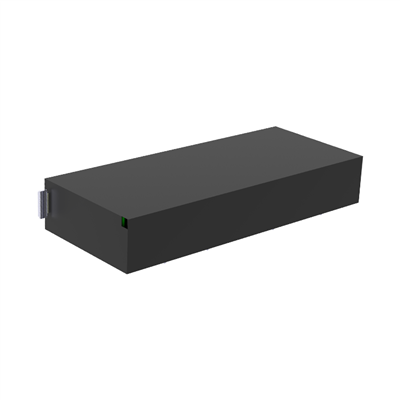
| Dimensions (Max) | 347 × 147 × 61 mm |
| Weight | Approximately 5kg |
| Cycle Life | 300+ cycles under standard conditions |
| Housing | Glass-fibre reinforced polycarbonate, sealed gasket |
| Shipping State | Charged to 50% or less, UN38.3 compliant for transport |
| Certifications | UN38.3, MSDS, CE, RoHS; UL documentation supported per batch |
| Connector | Per customer specification |
Product Highlights
A 917Wh pack that still fits a standard e-bike mounting footprint
At 347 × 147 × 61 mm and approximately 5kg, this 50.4V 18.2Ah 14S7P e-bike battery carries more energy than a typical 48V 18Ah pack while staying within the dimensions most 48V-class down-tube and rear-rack brackets accept. For builders upgrading an existing frame, that means the range gain does not require a new frame or a new mounting system.
27A continuous discharge with every cell working at only 3.9A
This is the part of the specification most listings do not explain. The 14S7P layout uses seven parallel groups, so the 27A continuous rating is shared across seven groups - each individual 18650 cell carries only 3.9A. That is a light, cool load for a cell, and it is the main reason this pack is rated for 300+ cycles while delivering consistent output. A pack that pushes its full rating through fewer cells runs hotter and ages faster.
Grade-A 18650 cells, matched group by group
Every cell is graded for capacity and internal resistance, then matched and welded group by group before assembly. The protection circuit module guards against over-charge, over-discharge, over-current, short-circuit and temperature excursions, and the pack ships with a tamper-proof state-of-charge indicator and a compliance certificate.
The enclosure is a high-impact polycarbonate reinforced with glass fibre, with shock-absorbing ribs and a sealed gasket system. Every housing design is validated through 10 hours of continuous vibration at 10–500Hz and 1.5m drop tests onto concrete - conditions matched to construction-site equipment, off-road scooters and delivery fleets rather than laboratory conditions.
Ships at 50% state of charge for safe transport and storage
Each unit leaves the facility at a state of charge strictly limited to 50% or less, aligned with UN38.3 and IATA dangerous-goods requirements. This lowers transit risk and avoids the accelerated degradation that occurs when lithium-ion cells are stored at full charge for extended periods.

Why 14S7P, and What It Means for Your Build
The two numbers in a configuration code do different jobs. In this 50.4V 18.2Ah 14S7P e-bike battery, both numbers are chosen to protect cycle life while raising usable energy per kilogram.
14S sets the voltage. Fourteen cells in series, each at 3.6V nominal, give 50.4V. Seven more cells in series would take you to 61.2V, which changes the charger, the controller and the motor - so the series count is a decision about the whole vehicle.
7P sets the capacity. Seven parallel groups of 2,600mAh cells give 7 × 2,600mAh = 18.2Ah rated capacity, with 7 × 2,500mAh = 17.5Ah as the minimum. The pack therefore holds 98 cells in total.
Why the parallel count matters more than it looks. More parallel groups mean the continuous current is divided between more cells. At 27A, a 7P arrangement puts 3.9A through each cell. In a 5P arrangement the same 27A would put 5.4A through each cell - nearly 40% more heat per cell, and a materially shorter service life at the same rated capacity. If you are comparing two packs with identical voltage and capacity but different P counts, the higher P number is usually the better-engineered one.
Voltage Explained: 50.4V, 52V and 58.8V
E-bike listings use three different numbers for what buyers treat as one battery. Here is what each one means for this pack.
| Figure | What it is | When you see it |
|---|---|---|
| 50.4V | The true nominal voltage - 14 cells × 3.6V | Technical datasheets, cell-level engineering |
| 52V | The trade name for that voltage class | Retail listings, e-bike manufacturers, model names |
| 58.8V | The full-charge voltage - 14 cells × 4.2V | Charger rating, your charge port |
52V and 50.4V are the same battery. 52V is a rounded label buyers and retailers use for the 14S class, and it is the number most searches use. If a listing says 52V 18Ah, this is the pack it refers to.
58.8V is not a separate voltage to worry about. It is what a correctly matched 58.8V charger delivers at the end of a charge, and it is the number that must match your charger's output. Pairing this pack with a 54.6V charger (a 13S charger) will undercharge it; pairing it with a 62V charger without a proper charge profile will overcharge it.
Range by Motor Power
Range for this 50.4V 18.2Ah 14S7P e-bike battery depends on energy drawn per kilometre, and energy per kilometre depends on how hard the motor is working. Using the 917Wh rating, a useful planning rule is 5 to 10 km per 100Wh under typical conditions.
| Motor class | Typical range | Note |
|---|---|---|
| 250W hub motor, eco assist, flat | 55 – 90 km | Best case; light rider, low assist |
| 500W mid-drive, mixed assist | 40 – 65 km | Most common commuter setup |
| 750W mid-drive, frequent high assist | 30 – 50 km | Performance mid-drives consume more per km |
| 750W mid-drive, loaded or hilly | 25 – 40 km | Grade and load dominate the loss |
What moves the number most: assist level, rider and cargo weight, gradient, wind, tyre pressure and temperature. Riders frequently quote 100 km on this pack in eco mode on flat ground, and 35 km on a hilly route at full assist. Both are consistent with the same battery.
A note on 917Wh versus Wh-based comparisons. Battery capacity in watt-hours is the only number that lets you compare across voltage classes, which is why a 50.4V 18.2Ah pack and a 48V 15Ah pack should be compared on watt-hours, not amp-hours. This pack holds approximately 917Wh - more usable energy than a standard 48V 18Ah pack, and a realistic upgrade for riders who have outgrown their original battery.

Charging Guide
The charging voltage for this pack is 58.8V, which corresponds to a 14S configuration with a 4.2V per cell charge profile. A 54.6V charger will not fully charge it. A 62V charger is only appropriate if its charge profile is explicitly specified for 14S lithium-ion, since a charger that pushes past 4.2V per cell will overcharge the pack.
At the pack's 27A continuous discharge rating, a matched 58.8V charger at 5A takes roughly 4 hours, and at 10A roughly 2 hours, assuming the charger runs a constant-current phase followed by a taper near full.
The charging temperature window for this pack is 10°C to 45°C. Charging a lithium-ion pack below 0°C causes lithium plating on the anode - permanent, cumulative damage that no amount of subsequent cycling reverses. In cold conditions, bring the battery indoors and let it reach room temperature first. The discharge window is wider at -15°C to 60°C, but cold capacity is reduced even when the pack will happily discharge.
Store at 40–60% charge in a cool, dry place around 10–20°C. Check the state of charge periodically during long storage, and never leave the pack on a charger indefinitely once it is full.
- TO CONFIRM: peak discharge rating for this model before publishing this sentence. Contact us for the value that matches your controller.
Cycle Life and Total Cost of Ownership
300+ full charge-discharge cycles under standard conditions. After 200 cycles the pack retains more than 80% of its original capacity, which keeps output consistent rather than progressively weaker. For a 50.4V 18.2Ah 14S7P e-bike battery sold into fleet and rental programs, that figure is usually the deciding number rather than the range figure.
The 300+ figure depends on how you treat the pack. It holds under standard conditions - a defined depth of discharge, a normal charge rate and a normal temperature. Deep discharge to the 39.2V cut-off on every ride, charging in the cold, and storage at full charge will all shorten it. A cycle also means a full charge and a full discharge; topping up from 50% counts as roughly half a cycle.
Why the cycle figure is a purchasing argument, not a spec-sheet line. At three years and roughly one charge per day, 300+ cycles is around the point most riders first consider a replacement. Against that, the pack is priced against far shorter-lived alternatives: an entry-level 36V pack typically manages 300–500 cycles, and general-purpose lithium e-bike packs commonly quote 500–1,000 cycles without stating the test condition. The number that matters is not the headline count but the curve behind it, and the depth of discharge it was measured at.
Ask any supplier for the curve. If they cannot tell you the depth of discharge, temperature and charge rate behind their cycle number, they are quoting a best case rather than a specification.
Comparison Table
How this 50.4V 18.2Ah 14S7P e-bike battery compares with the alternatives riders actually consider.
| Specification | This pack (50.4V 18.2Ah 14S7P) | Typical 48V 18Ah pack | Typical 52V 18Ah competitor | Lead-acid equivalent |
|---|---|---|---|---|
| Nominal voltage | 50.4V | 48V | 50.4–52V | 48V |
| Capacity | 18.2Ah (min 17.5Ah) | 18Ah | 18Ah | 20Ah |
| Energy | ≈ 917Wh | ≈ 864Wh | ≈ 900–950Wh | ≈ 960Wh |
| Cell count | 98 (14S7P) | Typically 13S5P | Often 14S6P | Lead plates |
| Continuous discharge | 27A | 25–30A | Frequently quoted 50A | 20–30A |
| Weight | ≈ 5kg | ≈ 5.5kg | 5.5–7kg | 11–13kg |
| Cycle life | 300+ (standard conditions) | 500–1,000 (condition-dependent) | Often stated without conditions | 200–500 |
| Maintenance | None | None | None | Electrolyte top-up |
| Service life in years | 3–5 | 3–5 | 3–5 | 1–2 |
| Weight saving vs lead-acid | ~10kg lighter | ~8kg lighter | ~8kg lighter | - |
Read the discharge column carefully. A large number of competitor listings quote 50A as the maximum working current without stating whether that figure is continuous or peak. This pack is rated 27A continuous - a figure you can hold indefinitely without the protection module cutting out.
MOQ, lead time and pricing: sample verification from one unit; bulk lead time typically 4–6 weeks depending on cell availability and engineering scope; volume pricing available on request. TO CONFIRM: minimum order quantity for this model. TO CONFIRM: indicative FOB price band for this model.

Applications
The 50.4V 18.2Ah 14S7P e-bike battery suits applications where service life and usable energy matter more than minimum weight..
E-bikes and e-scooters
In the 250W–750W class - the primary fit, and the reason the pack is built around seven parallel groups rather than fewer.
Shared fleets
Shared e-scooter and e-bike fleets - 27A continuous supports heavier riders and longer shift patterns, and the 300+ cycle rating is what fleet operators need to hit their replacement interval.
E-trikes
E-trikes and light electric vehicles - 917Wh covers typical three-wheeler duty cycles with margin.
Energy storage
Solar and energy storage adjuncts - a 14S storage pack where service life matters more than weight.
Power tools and medical
Power tools and medical devices - the 58.8V charge window and IP65 housing suit equipment that sees vibration and moisture.
Industrial backup
Industrial backup power units - ships at 50% state of charge, so it can be stored for months and deployed without a pre-charge cycle.
Every 50.4V 18.2Ah 14S7P e-bike battery program starts with a compatibility conversation, because the pack is frequently specified into an existing frame, controller and charger combination.
Send us your controller model, motor power, existing pack dimensions and required quantity, and we will return a compatibility note with a sample offer.
Cell format and pack dimensions adjustable within a safe envelope; 347 × 147 × 61 mm is the current standard build.
Protection configuration - over-charge, over-discharge, over-current, short-circuit and temperature thresholds set to your controller and charger.
Connector and terminal layout - position and polarity configurable to your compartment; connector supplied per your specification.
Communication options - UART and CAN bus variants available for fleet telemetry and battery-management integration. TO CONFIRM: confirm whether UART and CAN are available for this model.
Private label - enclosure, labelling, terminal marking and manual in your brand.
Documentation for your program - UN38.3 transport qualification, MSDS, CE and RoHS, with UL safety documentation supported for North American programs. Certificate numbers are issued per batch. TO CONFIRM: UL certificate number and issuing body for this model.
MOQ and lead time - sample verification from one unit; bulk lead time typically 4–6 weeks depending on cell availability and engineering scope.
Pricing - volume pricing available; send us your quantity, target motor power and existing pack dimensions for a quotation.
Quality and Manufacturing
Shenzhen RYDBATT Electronics Co., Ltd. (headquarters) and Huizhou RYDBATT New Energy Co., Ltd. (Huizhou plant). Every 50.4V 18.2Ah 14S7P e-bike battery leaves the line having passed the same functional test sequence, whatever the order quantity.
- In-house pack assembly with cell matching and protection module integration.
- Every pack function-tested before dispatch - capacity, voltage, protection thresholds and continuity.
- Batch traceability: cell lot, assembly date and test record tied to each serial number.
- Environmental validation across extreme temperature, humidity, rapid thermal cycling, vibration, shock and dust ingress.
- Safety validation covering over-charge and over-discharge protection, short-circuit resistance, thermal stability and puncture resistance.
- Export documentation handled for EU, UK, US and other destination markets.
Frequently Asked Questions
Q: What is the model, cell chemistry, and cell configuration of this battery pack?
A: Model: Li-18650-14S7P-50.4V 18.2Ah-PCM. Cell chemistry: Li-ion (18650). Cell configuration: 14S7P - 98 cells.
Q: What are the nominal voltage, nominal capacity, and rated energy?
A: Nominal voltage: 50.4V (14S), commonly called 52V. Nominal capacity: 18.2Ah (minimum 17.5Ah). Rated energy: approximately 917Wh.
Q: What are the charging voltage, discharge cut-off, and maximum continuous discharge current?
A: Charging voltage: 58.8V. Discharge cut-off: 39.2V. Max continuous discharge current: 27A.
Q: What are the operating temperature ranges and safety protection functions?
A: Charging temperature: 10°C to 45°C. Discharging temperature: -15°C to 60°C. Safety protection: PCM with over-charge, over-discharge, over-current, short-circuit, and temperature control. IP rating: IP65.
Q: What are the maximum dimensions, weight, and housing material?
A: Maximum dimensions: 347 × 147 × 61 mm. Weight: approximately 5kg. Housing: glass-fibre reinforced polycarbonate with sealed gasket.
Q: What is the cycle life?
A: 300+ cycles under standard conditions.
Q: What is the shipping state, what certifications are supported, and can the connector be customized?
A: Shipping state: charged to 50% or less, UN38.3 compliant for transport. Certifications: UN38.3, MSDS, CE, RoHS; UL documentation supported per batch. Connector: per customer specification.
Hot Tags: 50.4v 18.2ah 14s7p e-bike battery 917wh rydbatt, electric scooter battery, 50.4v 18.2ah 14s7p e-bike battery 917wh rydbatt manufacturer, 50.4v 18.2ah 14s7p e-bike battery 917wh rydbatt supplier, OEM battery, RYDBATT, 36V Scooter Battery Pack, 10S4P Lithium Battery Pack, scooty battery wali price, scooty battery voltage, scooter battery pack 48.1V 12.8Ah, best scooter battery