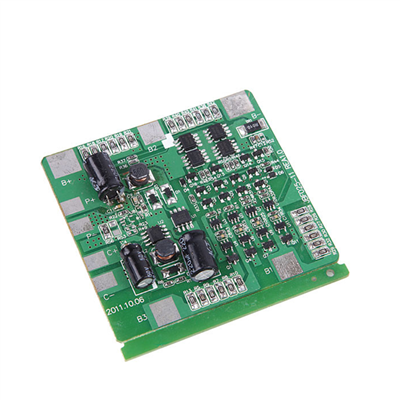

Hey there! As a supplier of 4S BMS for Li-ion batteries, I often get asked about the maximum voltage difference allowed between cells in a Li-ion battery with a 4S BMS. It's a crucial question, and in this blog, I'll break it down for you.
First off, let's understand what a 4S BMS is. A 4S BMS, or 4-cell series Battery Management System, is designed to manage a battery pack composed of four Li-ion cells connected in series. Its main job is to ensure the safety, longevity, and optimal performance of the battery pack. Now, when it comes to the voltage difference between cells, it's a key factor that can significantly impact the battery's health and performance.
In a Li-ion battery pack, each cell should ideally have the same voltage. However, in the real world, there are always slight variations. These variations can occur due to differences in cell manufacturing, temperature, and usage patterns. If the voltage difference between cells becomes too large, it can lead to several problems.
One of the biggest issues is overcharging or undercharging of individual cells. When a cell is overcharged, it can cause thermal runaway, which is a dangerous condition where the cell heats up uncontrollably and can even catch fire or explode. On the other hand, an undercharged cell can lead to reduced capacity and a shorter lifespan for the entire battery pack.
So, what's the maximum voltage difference allowed between cells in a 4S BMS? Well, the general consensus in the industry is that the maximum voltage difference should be kept within 50 - 100 mV (millivolts). This means that the voltage of any single cell in the 4S battery pack should not deviate from the average cell voltage by more than 50 - 100 mV.
Let me explain why this range is so important. If the voltage difference is within this range, the BMS can effectively balance the cells. Balancing is the process of equalizing the voltage of all cells in the battery pack. The BMS does this by either charging or discharging individual cells as needed. For example, if one cell has a slightly higher voltage than the others, the BMS will discharge that cell until its voltage matches the rest.
However, if the voltage difference exceeds 100 mV, the BMS may struggle to balance the cells effectively. This can lead to an imbalance that gets worse over time, ultimately reducing the battery's performance and lifespan. In some cases, it can even pose a safety risk.
Now, you might be wondering how to ensure that the voltage difference between cells stays within the acceptable range. Well, that's where a high-quality 4S BMS comes in. Our 4S BMS for Li Ion Battery is designed with advanced balancing technology to keep the voltage difference between cells in check. It constantly monitors the voltage of each cell and takes corrective action as needed.
In addition to using a good BMS, proper battery maintenance is also crucial. This includes avoiding overcharging and over-discharging the battery pack, as well as keeping the battery at a moderate temperature. Temperature can have a significant impact on cell voltage, so it's important to store and use the battery in a cool, dry place.


Another factor to consider is the type of Li-ion cells used in the battery pack. Different types of Li-ion cells have different voltage characteristics, so it's important to choose cells that are compatible with your BMS. Our BMS is compatible with a wide range of Li-ion cells, including 7.2V Li-ion Li-Polymer Battery BMS and Battery Management System for 18650.
In conclusion, the maximum voltage difference allowed between cells in a 4S BMS should be kept within 50 - 100 mV to ensure the safety, performance, and longevity of the battery pack. Using a high-quality BMS and practicing proper battery maintenance are key to achieving this.
If you're in the market for a reliable 4S BMS for your Li-ion battery pack, we'd love to hear from you. Whether you're a small business looking to power your devices or a large-scale manufacturer, our BMS solutions can meet your needs. Reach out to us to start a conversation about your specific requirements and see how we can help you get the most out of your Li-ion batteries.
References
- Battery University: https://batteryuniversity.com/
- Journal of Power Sources