

|
881 Wh |
30 / 130 A |
CANopen |
4.1 kg |
|
TOTAL ENERGY |
CONT / PULSE |
125 kbit/s |
FLIGHT-READY |
Flight-Grade Power Overview
The RYDBATT 40.8V 21.6Ah drone battery pack is a flight-grade 881 Wh lithium-ion power system built for industrial UAVs that cannot afford a voltage sag mid-air. Engineered on a 12S2P layout of grade-A high-energy-density Li-ion cells (215 Wh/kg pack-level), it delivers 30A continuous and 130A 10-second pulse discharge, CANopen 125 kbit/s telemetry, and a dual-layer protection architecture that keeps working even if the main processor never wakes up.
Every pack ships in a protective case at 40-41 V shipping voltage (SoC ≤30% for compliant transport), file-numbered for traceability from cell lot to final test data. Model LP-6252144-12S2P-40.8V21.6Ah.
Whether you integrate inspection, agriculture, mapping or delivery drones, this 21.6Ah UAV battery gives your flight controller per-cell visibility and your fleet a documented, batch-tested energy source.
881 Wh total energy - about 30% more flight energy per kg.
21.6Ah at 40.8V in a 12S2P layout of matched, lot-traceable grade-A cells for a consistent 215 Wh/kg pack-level density.
30A / 130A discharge - power that holds under full throttle.
30A continuous covers sustained cruise, hover-in-wind and payload work; a 10-second 130A pulse absorbs takeoff climbs, gust compensation and emergency maneuvers. ≤60 mΩ pack impedance keeps voltage sag under 5% from 100% to 5% state of charge.
CANopen 125 kbit/s telemetry - no analog guesswork.
Per-cell voltage, temperature, SoC and protection events stream to your flight controller in real time over a standard CANopen bus (protocol documentation under NDA).
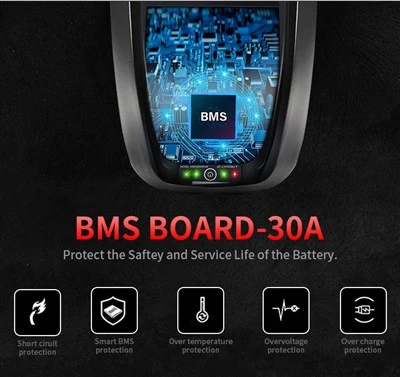
Redundant protection - two-tier MCU cutoffs backed by 7 fuses.
Two-tier cell OVP (4.23 V / 4.265 V, release 4.10 V; pack cutoff 50.76 V), staged over-current (charge OCP 30A then 60A; discharge alerts at 60A/5 min and 145A/10 s), deep-discharge lock at 2.8 V with wake-on-charger only, full thermal coverage, ±4 kV contact / ±8 kV air ESD immunity, and auto-sleep at 300-500 µA idle.
Hardware last line - 7 independent fuses.
2 × 30A charge-path fuses and 5 × 40A discharge-path fuses back up the MCU cutoffs, keeping working even if the processor locks up.
Auto cell balancing.
Starts at 4.0 V on a ≥30 mV cell delta and closes to ≤10 mV (~84 mA per cell), active in charge or idle - keeping every cell inside its safe window across the fleet's life.
Applications
 Built from the cell up: matched 12S2P grade-A cells, dual smart BMS boards, 7 independent fuses
Powerline & pipeline inspection - hover-in-wind station-keeping with fleet telemetry logs.
Agriculture - full-payload spray passes with reliable -20°C cold starts.
Mapping & LiDAR - clean voltage for scan-critical payloads.
Logistics delivery - 130A pulse for loaded vertical takeoffs.
Public safety - 60°C heat and smoke-line sealed operation.
Cinematography - no brownouts under gimbal and focus load.
Reference flight time: 20-45 minutes on mid-size industrial multirotors at a 1.2-2.5 kW average draw.
Technical Specifications
|
Item |
Value |
Note |
|
Model |
LP-6252144-12S2P |
PCM with protective case |
|
Configuration |
12S2P |
12 series × 2 parallel |
|
Nominal voltage |
40.8 V |
Mean operating voltage |
|
Rated capacity |
21.6 Ah typ / 20.5 Ah min |
After standard charge |
|
Total energy |
881 Wh |
About 215 Wh/kg pack-level |
|
Charge voltage |
50.4 V |
CC/CV, cut-off ≤0.02C |
|
Discharge cut-off |
30 V |
Pack level |
|
Standard charge / discharge |
4.4 A (0.2C) |
25 ± 2°C ambient |
|
Max charge current |
11 A (10-20°C) / 25 A (20-60°C) |
Temperature-tiered |
|
Max continuous discharge |
30 A |
Sustained |
|
Pulse discharge |
130 A / 10 s |
Takeoff & gust headroom |
|
Impedance |
≤60 mΩ |
AC 1 kHz, fresh pack |
|
Cycle life |
>100 cycles |
1C to 30 V, ≥80% retention |
|
Capacity retention |
≥85% after 28 days |
Stored at 25 ± 5°C |
|
Operating temperature |
Charge 0~50°C · Discharge -20~60°C |
60 ± 25% RH |
|
Storage temperature |
-20~30°C (1 yr) · best 10~25°C |
Long-term |
|
Shipping voltage |
40-41 V |
SoC ≤30% for transport |
|
Weight |
≈4.1 kg |
With protective case |
|
Dimensions (max) |
186.9 × 167.5 × 120.25 mm |
± 1.0 mm |
|
Communication |
CANopen 125 kbit/s |
Smart BMS telemetry |
|
Cell over-charge protection |
4.23 V / 4.265 V · release 4.10 V |
Two-tier |
|
Hardware fusing |
30 A × 2 charge · 40 A × 5 discharge |
Independent of MCU |
|
NOTE |
||
|
Values are from the factory specification sheet; production packs are tested against this table on every batch. Custom ranges available via OEM/ODM. |
||
Technical Specifications
Certification & Testing
UN38.3 - air & sea freight test summary with every order.
UL 1642 - lithium cell safety, listed cells.
UL 2054 - household & commercial pack safety.
IEC 62133-2 - sealed Li-ion cell & pack safety (international).

ISO 9001 - 2015 quality management, full traceability.
In-house ISO laboratories run UN38.3 / UL protocols plus cycle-life, ≤60 mΩ impedance, -40~+85°C environmental and BMS functional tests on every batch. Reports are available under NDA. Every pack ships cycle-tested with file-numbered traceability and a 12-month manufacturer warranty (24- or 36-month extended terms for volume OEM customers, confirmed on quotation).
OEM / ODM Custom Capability
Your brand, our factory - from 50 pcs. Customize capacity & voltage, discharge profile, BMS firmware, connectors and cable routing, label & packaging. Engineering samples in 7 days; bulk production in 25-30 days. RYDBATT adapts the 12S2P platform to your airframe's voltage window, current demand and CAN protocol version - with DFM review on enclosure, thermal path and connector position before tooling.
Factory Quality Backing
RYDBATT flight-grade lithium battery systems since 2005 - 20+ years of battery engineering across two sites: Shenzhen RYDBATT Electronics Co., Ltd. (HQ) and Huizhou RYDBATT New Energy Co., Ltd. (manufacturing plant, 84,000 m²). In-house cell matching, automated pack assembly, 100% batch EOL testing (capacity, impedance, CAN telemetry, protection trigger) and file-numbered traceability give drone integrators an auditable supply chain, not just a datasheet.
FAQ
The answers below cover the questions drone integrators ask most before specifying this 40.8V 21.6Ah UAV battery. For integration documents beyond this list, contact our engineering team.
Q: 1: What flight time can I expect with the 881 Wh pack?
A: 20-45 minutes on mid-size industrial multirotors at a 1.2-2.5 kW average draw, depending on payload, wind and hover throttle. Contact us with your airframe's power profile for a projected endurance table.
Q: 2: Does the CANopen protocol documentation come with the pack?
A: The bus runs standard CANopen at 125 kbit/s reporting cell V/T, SoC and protection events. The object dictionary and protocol document are shared under NDA so your firmware team can integrate quickly.
Q: 3: Can I charge this battery below 0°C?
A: No - charging is inhibited below 0°C to protect cell chemistry. Discharge works down to -20°C. The BMS enforces the temperature window automatically.
Q: 4: What is the difference between 30A continuous and 130A pulse?
A: 30A continuous is the sustained current for cruise and hover; the 130A rating applies for 10 seconds, sized for takeoff climbs, gust recovery and emergency maneuvers. The BMS applies staged alerts (60A/5 min, 145A/10 s) before hard cutoff.
Q: 5: How does the two-tier over-voltage protection work?
A: Per-cell charge cutoff at 4.23 V, then 4.265 V per cell as the second tier; both release at 4.10 V. A pack-level cutoff at 50.76 V covers the case of a single-cell sensing fault - protection does not rely on one measurement.
Q: 6: What do the 7 hardware fuses protect?
A: 2 × 30A on the charge path and 5 × 40A on the discharge path. They back up the MCU cutoffs as independent last-line protection - if the processor locks up, the fuses and cell-level lockouts keep working.
Q: 7: What is the shipping voltage and why?
A: Packs ship at 40-41 V (SoC ≤30%) for compliant, low-stress air and sea transport per UN38.3, and store best at -20~30°C (10~25°C long-term) with ≥85% capacity retention after 28 days.
Q: 8: How is traceability documented?
A: Every pack carries a file number linking its cell lot, BMS firmware version and batch test data - cycle-life, impedance and environmental results are available for vendor audits under NDA.
Hot Tags: 40.8v 21.6ah drone battery pack, high-drain battery cell, 40.8v 21.6ah drone battery pack manufacturer, 40.8v 21.6ah drone battery pack supplier, OEM battery, RYDBATT, 40.8V 21.6Ah Drone Battery Pack