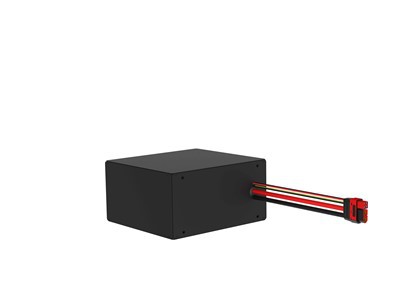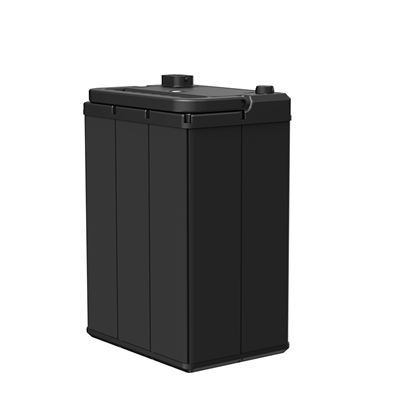
Main Components of Lithium‑Ion Batteries
(1) Cathode (Positive Electrode) – The active materials mainly include lithium cobalt oxide, lithium manganate, lithium iron phosphate, lithium nickel oxide, nickel‑cobalt‑manganese ternary materials, etc. Aluminum foil with a thickness of 10–20 micrometers is generally used as the conductive current collector.
(2) Separator – A special plastic membrane that allows lithium ions to pass through while insulating electrons. Currently, it is mainly made of PE, PP or their composites. There are also inorganic solid separators; for instance, an alumina‑coated separator is a type of inorganic solid separator.
(3) Anode (Negative Electrode) – The active materials mainly include graphite, lithium titanate, or carbon materials with graphite‑like structures. Copper foil with a thickness of 7–15 micrometers is commonly used as the conductive current collector.
(4) Electrolyte – Generally an organic system, such as carbonate‑based solvents dissolved with lithium hexafluorophosphate. Some polymer batteries adopt gel‑type electrolytes.
(5) Battery Case – Divided mainly into hard cases (steel shells, aluminum shells, nickel‑plated iron shells, etc.) and soft‑pack cases (aluminum‑plastic film).
During charging, lithium ions de‑intercalate from the cathode and intercalate into the anode; the reverse occurs during discharging. One electrode needs to be in a lithium‑intercalated state before assembly. Lithium‑intercalated transition metal oxides with a potential higher than 3 V relative to lithium and stable in air are generally selected as cathode materials, such as LiCoO₂, LiNiO₂ and LiMn₂O₄.
Anode materials are lithium‑intercalable compounds with potentials as close to that of lithium as possible, including various carbon materials (natural graphite, synthetic graphite, carbon fiber, mesocarbon microbeads, etc.) and metal oxides such as SnO, SnO₂ and tin composite oxides SnBₓPᵧO_z (x=0.4–0.6, y=0.6–0.4, z=(2 + 3x + 5y)/2).
The electrolyte adopts a mixed solvent system of alkyl carbonates such as ethylene carbonate (EC), propylene carbonate (PC) and low‑viscosity diethyl carbonate (DEC) dissolved with LiPF₆.
Separators are polyolefin microporous films of PE, PP or their composites. In particular, PP/PE/PP three‑layer separators feature a low melting point and high puncture resistance, serving as a thermal safety fuse.
Cases are made of steel or aluminum, and cover assemblies are equipped with explosion‑proof and power‑cutoff functions.
Basic Working Principle
When the battery is charged, lithium ions are extracted from lithium‑containing compounds in the cathode and migrate through the electrolyte to the anode. The carbon material of the anode has a layered structure with numerous micropores, where lithium ions are embedded. More embedded lithium ions mean higher charging capacity.
During discharge (when the battery is in use), lithium ions embedded in the carbon layers of the anode are extracted and migrate back to the cathode. More lithium ions returning to the cathode correspond to higher discharge capacity. The battery capacity we normally refer to is the discharge capacity.
During charge‑discharge cycles of lithium‑ion batteries, lithium ions shuttle back and forth between the cathode and the anode. This is analogous to a rocking chair: the two ends of the chair represent the two electrodes, and lithium ions move repeatedly between them. Hence, lithium‑ion batteries are also known as rocking‑chair batteries.
Charge‑Discharge Mechanism
The charging process of lithium‑ion batteries consists of two stages: constant‑current charging and constant‑voltage charging with gradually decreasing current.
Over‑charging and over‑discharging cause permanent damage to the cathode and anode. Over‑discharge leads to collapse of the layered structure of anode carbon, preventing lithium ions from intercalating during subsequent charging. Over‑charging embeds excessive lithium ions into the anode carbon structure, leaving some lithium ions permanently non‑extractable.
The optimal charge‑discharge pattern for maintaining lithium‑ion battery performance is shallow charging and shallow discharging. Generally, the cycle life under 60% depth of discharge (DOD) is 2–4 times that under 100% DOD.