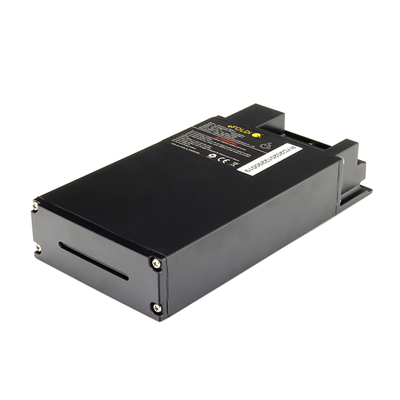
Anatomy of Battery Management System (BMS)
Estimating Battery State of Charge (SOC) via Ampere-hour Integration Method
01 Mathematical Formula
The Ampere-hour Integration method (also known as Coulomb Counting) is a widely used technique for estimating battery SOC. Its fundamental principle is to integrate current over time to determine the variation in the battery's SOC.

The mathematical formula for SOC calculation is as follows:

Where:
SOC0: Initial SOC (State of Charge)
Qn: Nominal/Rated capacity of the battery
η: Coulombic efficiency (accounting for charge/discharge efficiency)
I(r): Real-time current (defined as positive during charging and negative during discharging)
02 Detailed Example of Ampere-hour Integration
To thoroughly understand the calculation mechanism of the Ampere-hour Integration method under dynamic operating conditions, let us analyze a case study involving real-time current integration.
Step 1: Determine the Initial SOC and Battery Capacity
Assume the battery's initial SOC is 100% (fully charged status) and its rated capacity is 100 Ah (Ampere-hours).
Step 2: Record Current and Time
Record the battery current profile over time during a specific period.
1st Hour: The battery discharges at a constant current of -5 A.
2nd Hour: The battery continues to discharge, and the current changes to -3 A.
3rd Hour: The battery charges, and the current changes to +2 A.
Note: Current is negative during discharging and positive during charging.

Step 3: Calculate the Change in Battery Charge (\(Q\))
According to the formula for electric charge: Q=i*t
1st Hour: △Q1=-5A×1h =-5Ah
2nd Hour: △Q2=-3A×1h =-3Ah
3rd Hour:△Q3=+2A×1h =+2Ah
Total Charge Variation : △Q=△Q1+△Q2+△Q3=(-5Ah)+(-3Ah)+(+2Ah) =-6Ah
Step 4: Calculate the Current SOC
100%SOC=100%+(-6Ah/100Ah)×100%=94%
03 Calculation Workflow
Based on the example above, the calculation workflow of the Ampere-hour Integration method can be summarized as follows:
Measure Current: First, measure the current values during battery charging and discharging (the methods for current measurement have been introduced previously; interested readers can click the link at the beginning of the article to view them).
Record Time: Log the current values along with their corresponding timestamps.
Compute Period Charge: Calculate the change in charge within each sampling period ix△t.
Accumulate Charge: Sum up the charge variations across all sampling periods.
Estimate Current SOC: Estimate the current SOC based on the initial SOC value and the accumulated charge variation.
04 Key Considerations
Current Measurement Accuracy: The accuracy of current measurements directly impacts the precision of the SOC estimation.
Rated Capacity Acquisition: The rated capacity of the battery must be obtained accurately.
Limitations and Multi-algorithm Fusion: The Ampere-hour Integration method cannot account for the effects of battery temperature, aging, and other factors on battery capacity. In practical applications, it is commonly fused with other methods (such as the Open Circuit Voltage [OCV] method) to enhance the accuracy of SOC estimation.