



Hey there! As a supplier of li ion battery chargers, I've seen firsthand how the design of these chargers can have a huge impact on their performance. In this blog post, I'm gonna break down the key design elements and explain how they affect how well a charger works.

Charging Circuit Design
The charging circuit is the heart of a li ion battery charger. It's responsible for regulating the voltage and current that gets sent to the battery. A well - designed charging circuit can make all the difference in how fast and safely a battery charges.
One of the most important aspects of the charging circuit is the charging algorithm. There are different stages in charging a li ion battery, like the constant - current (CC) stage and the constant - voltage (CV) stage. In the CC stage, the charger supplies a steady current to the battery until it reaches a certain voltage. Then, in the CV stage, the charger maintains a constant voltage while the current gradually decreases as the battery gets fully charged.
If the charging algorithm isn't set up right, it can lead to overcharging or undercharging. Overcharging is a big no - no because it can cause the battery to overheat, swell, or even catch fire. Undercharging, on the other hand, means the battery won't reach its full capacity, which shortens its overall runtime.
For example, our E - Bike Charger 42V 3A uses a carefully calibrated charging circuit. The algorithm is optimized to ensure that the e - bike battery gets charged quickly and safely. This design allows the charger to provide a consistent charge, which extends the battery's lifespan and improves its performance.
Power Supply Design
The power supply of a li ion battery charger is another crucial factor. It provides the electrical energy needed to charge the battery. There are two main types of power supplies: linear and switching.
Linear power supplies are simple and produce very little noise. They work by using a transformer to step down the input voltage and then regulate it using a linear regulator. However, they're not very efficient, especially when dealing with high - power chargers. They tend to get hot because they dissipate a lot of energy as heat.
Switching power supplies, on the other hand, are much more efficient. They use a switching regulator to convert the input voltage to the desired output voltage. This process involves rapidly switching the current on and off, which reduces energy loss. As a result, switching power supplies can handle higher power levels without getting as hot as linear power supplies.
Our 54.6V 5A Li - ion Smart Charger features a high - efficiency switching power supply. This design not only allows the charger to charge the battery faster but also reduces the amount of heat generated. Less heat means less stress on the charger's components, which improves its reliability and longevity.
Thermal Management Design
Heat is the enemy of li ion battery chargers. When a charger gets too hot, it can damage its internal components and reduce its performance. That's why thermal management is so important in charger design.
There are several ways to manage heat in a charger. One common method is to use heat sinks. Heat sinks are made of materials with high thermal conductivity, like aluminum. They absorb the heat generated by the charger's components and dissipate it into the surrounding air.
Another way is to use fans. Fans can help to increase the airflow around the charger, which speeds up the cooling process. Some chargers are designed with ventilation holes to allow hot air to escape and cool air to enter.
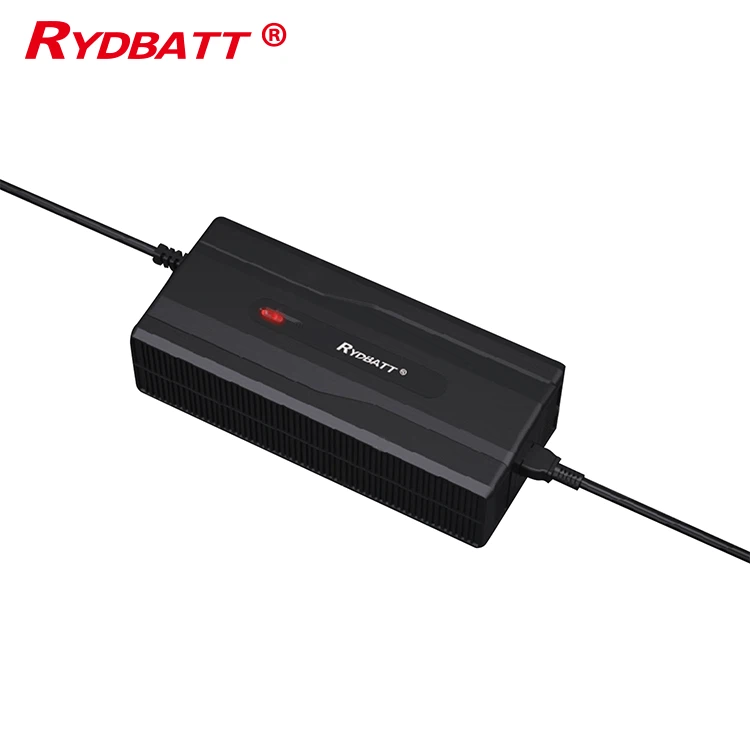
Our Li Ion Battery Charger 54.6 V has a well - thought - out thermal management system. It uses a combination of heat sinks and ventilation holes to keep the temperature in check. This ensures that the charger can operate at peak performance even during long - term charging sessions.
Safety Feature Design
Safety should always be a top priority when it comes to li ion battery chargers. There are several safety features that can be incorporated into the design to prevent accidents.
Over - voltage protection is one such feature. It ensures that the voltage supplied to the battery never exceeds a safe level. If the voltage starts to get too high, the charger will automatically shut off or reduce the voltage.
Over - current protection is also important. It prevents the charger from supplying too much current to the battery, which can cause overheating and damage.
Short - circuit protection is another essential safety feature. If a short circuit occurs, the charger will immediately cut off the power to prevent any damage to the battery or the charger itself.
All of our chargers are equipped with these safety features. We understand that our customers rely on our chargers to keep their batteries safe, and we take that responsibility seriously.
Physical Design
The physical design of a li ion battery charger can also affect its performance. A charger that's well - built and easy to use is more likely to be used correctly, which in turn improves its performance.
The size and shape of the charger matter. A compact charger is more portable, which is great for users who are on the go. However, it also needs to be designed in a way that allows for proper ventilation and heat dissipation.
The connector design is also important. A good connector should fit securely onto the battery, ensuring a stable electrical connection. It should also be durable enough to withstand repeated use.
We pay close attention to the physical design of our chargers. We want them to be not only functional but also user - friendly. Our chargers are designed with ergonomics in mind, making them easy to hold and operate.
Conclusion
As you can see, the design of a li ion battery charger has a profound impact on its performance. From the charging circuit to the physical design, every aspect plays a role in how well the charger works.
At our company, we're constantly working on improving our charger designs. We use the latest technology and best practices to ensure that our chargers are efficient, safe, and reliable. If you're in the market for a high - quality li ion battery charger, we'd love to talk to you. Whether you need a charger for an e - bike, a power tool, or any other device that uses li ion batteries, we've got you covered. Reach out to us to discuss your specific needs and let's start a conversation about how we can provide you with the perfect charger solution.
References
- Linden, D., & Reddy, T. B. (2002). Handbook of Batteries. McGraw - Hill.
- Berrueta, J., & Vázquez, S. (2014). Lithium - ion Batteries: Fundamentals and Applications. CRC Press.


