



Nickel-metal hydride (NiMH) batteries are widely used in various electronic devices due to their high energy density, long cycle life, and relatively low self-discharge rate. As a leading NiMH battery charger supplier, I am often asked about how these chargers work. In this blog post, I will explain the working principles of NiMH battery chargers, including the charging process, charging methods, and safety features.
The Basics of NiMH Batteries
Before delving into how NiMH battery chargers work, it's essential to understand the basic structure and chemistry of NiMH batteries. A NiMH battery consists of a positive electrode (cathode) made of nickel hydroxide (Ni(OH)₂), a negative electrode (anode) made of a hydrogen-absorbing alloy, and an alkaline electrolyte, usually potassium hydroxide (KOH).
During the charging process, an electrical current is applied to the battery, causing a chemical reaction at the electrodes. At the cathode, nickel hydroxide is oxidized to nickel oxyhydroxide (NiOOH), and at the anode, hydrogen ions are absorbed by the hydrogen-absorbing alloy. When the battery is discharged, the reverse reactions occur, releasing electrical energy.
The Charging Process
The charging process of a NiMH battery charger can be divided into several stages: pre-charge, fast charge, top-off charge, and trickle charge.
Pre-charge
When a NiMH battery is deeply discharged or has been stored for a long time, its voltage may be very low. In this case, a pre-charge stage is necessary to bring the battery voltage up to a safe level before starting the fast charge. The pre-charge current is usually relatively low, typically around 0.1C (where C is the battery's rated capacity). For example, if a battery has a capacity of 2000mAh, a 0.1C pre-charge current would be 200mA.
Fast Charge
Once the battery voltage reaches a certain threshold, the charger switches to the fast charge stage. During this stage, a higher current is applied to the battery to quickly replenish its energy. The fast charge current is typically between 0.5C and 1C. For instance, for a 2000mAh battery, a 0.5C fast charge current would be 1000mA, and a 1C fast charge current would be 2000mA.
The fast charge stage is the most critical part of the charging process, as it determines how quickly the battery can be charged. However, charging at a high current also generates heat, which can cause the battery temperature to rise. If the temperature gets too high, it can damage the battery and reduce its lifespan. Therefore, most NiMH battery chargers are equipped with temperature sensors to monitor the battery temperature during the fast charge stage.
Top-off Charge
After the fast charge stage, the battery is almost fully charged, but its voltage may not have reached its maximum value. The top-off charge stage is used to ensure that the battery is fully charged by applying a lower current for a short period. The top-off charge current is usually around 0.1C to 0.2C.
Trickle Charge
Once the battery is fully charged, a trickle charge is applied to maintain the battery's charge level. The trickle charge current is very low, typically around 0.05C. This stage helps to compensate for the self-discharge of the battery and keeps it ready for use.
Charging Methods
There are several charging methods used in NiMH battery chargers, including constant current (CC) charging, constant voltage (CV) charging, and a combination of both (CC-CV) charging.
Constant Current (CC) Charging
In CC charging, the charger maintains a constant current throughout the charging process. This method is suitable for the fast charge stage, as it allows the battery to be charged quickly. However, as the battery approaches full charge, its internal resistance increases, which can cause the battery voltage to rise rapidly. If the charging current is not reduced, it can overcharge the battery and damage it.
Constant Voltage (CV) Charging
In CV charging, the charger maintains a constant voltage across the battery terminals. As the battery charges, its internal resistance decreases, and the charging current gradually decreases. This method is often used in the top-off charge and trickle charge stages to prevent overcharging. However, CV charging alone is not sufficient to fully charge a NiMH battery, as it may not provide enough energy to reach the battery's full capacity.
Constant Current - Constant Voltage (CC-CV) Charging
Most modern NiMH battery chargers use a combination of CC and CV charging methods. During the fast charge stage, the charger applies a constant current to the battery until it reaches a certain voltage. Then, the charger switches to the CV mode and maintains a constant voltage while the charging current gradually decreases. This method ensures that the battery is charged quickly and safely.
Safety Features
To ensure the safety and longevity of NiMH batteries, NiMH battery chargers are equipped with various safety features.
Overcharge Protection
Overcharging a NiMH battery can cause it to overheat, vent, or even explode. To prevent overcharging, most chargers use a combination of voltage and temperature sensors to monitor the battery's state during the charging process. When the battery voltage reaches a certain threshold or the battery temperature exceeds a safe limit, the charger automatically stops the charging process.
Over-discharge Protection
Over-discharging a NiMH battery can also damage it and reduce its lifespan. Some NiMH battery chargers are equipped with over-discharge protection, which prevents the battery from being discharged below a certain voltage. This feature is especially important for devices that use multiple batteries in series, as it ensures that all the batteries are discharged evenly.
Short Circuit Protection
Short circuits can occur if the battery terminals are accidentally connected to each other or to a conductive object. To prevent short circuits, NiMH battery chargers are designed with short circuit protection mechanisms. If a short circuit is detected, the charger immediately stops the charging process and isolates the battery from the power source.
Reverse Polarity Protection
Connecting a battery to a charger with the wrong polarity can damage the battery and the charger. To prevent this, most NiMH battery chargers are equipped with reverse polarity protection. If the battery is inserted with the wrong polarity, the charger will not start the charging process and may display an error message.
Our NiMH Battery Chargers
As a NiMH battery charger supplier, we offer a wide range of high-quality chargers to meet the needs of different customers. Our chargers are designed with advanced charging algorithms and safety features to ensure the fast, safe, and efficient charging of NiMH batteries.
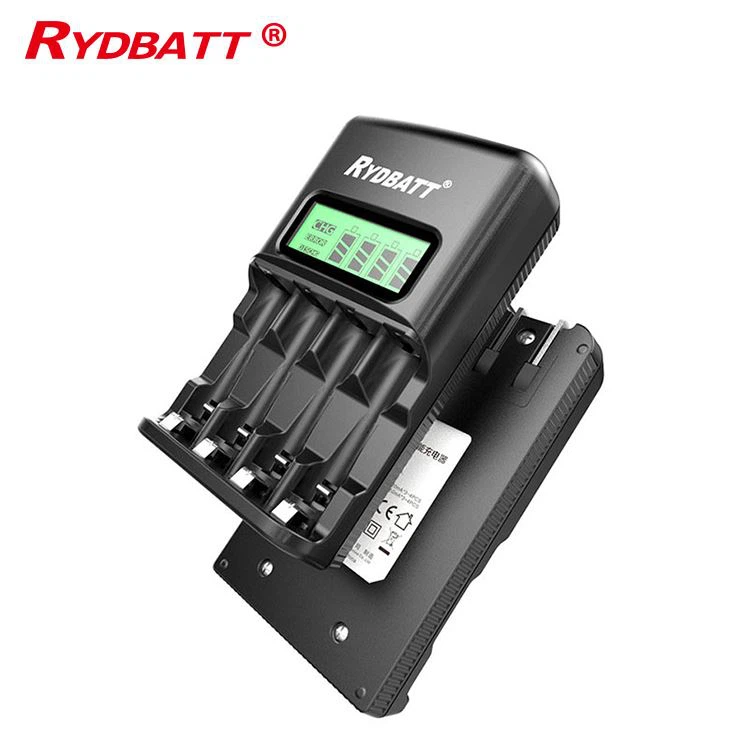
One of our popular products is the 4 Slot NiMH Charger with LCD Display. This charger can charge up to four NiMH batteries simultaneously and features an LCD display that shows the charging status of each battery. It uses a CC-CV charging method and is equipped with overcharge, over-discharge, short circuit, and reverse polarity protection.
Another product is the 16 Slot NiMH Charger with LCD Display. This charger is suitable for large-scale applications, such as charging batteries for industrial equipment or electric vehicles. It can charge up to 16 NiMH batteries at the same time and provides a high charging current for fast charging.
We also offer a 12 Slot NiMH Charger with LCD Display, which is a great choice for medium-sized applications. It combines the advantages of high charging capacity and compact design, making it ideal for charging batteries for remote controls, toys, and other small electronic devices.

Conclusion
In conclusion, NiMH battery chargers work by controlling the charging current and voltage to ensure the safe and efficient charging of NiMH batteries. The charging process consists of several stages, including pre-charge, fast charge, top-off charge, and trickle charge, and different charging methods are used to optimize the charging performance. Safety features such as overcharge protection, over-discharge protection, short circuit protection, and reverse polarity protection are essential to prevent damage to the battery and the charger.
If you are interested in our NiMH battery chargers or have any questions about their working principles, please feel free to contact us for more information and to discuss your procurement needs. We are committed to providing high-quality products and excellent customer service.
References
- Linden, D., & Reddy, T. B. (2002). Handbook of Batteries (3rd ed.). McGraw-Hill.
- Kordesch, K., & Simader, G. (1996). Nickel-Metal Hydride Batteries. John Wiley & Sons.
- Römhild, R., & Weydanz, W. (2000). Battery Charging Technologies. Springer.


